
ATS-Optimized for US Market

Lead Manufacturing Data Scientist Career & Resume Guide

As a Lead Manufacturing Data Scientist, your resume must demonstrate a potent blend of technical expertise, leadership acumen, and manufacturing domain knowledge to resonate with hiring managers. This is a leadership role, thus your resume should showcase your ability to not only develop advanced analytical solutions, but also to drive their adoption and impact within a manufacturing environment. The resume should highlight experiences where you led data science projects, mentored junior data scientists, and effectively communicated complex findings to non-technical stakeholders. Quantify your achievements wherever possible, emphasizing cost savings, efficiency gains, or quality improvements resulting from your data-driven initiatives. Essential sections include a compelling summary highlighting your leadership experience and technical proficiencies (Python, R, SQL, machine learning algorithms, statistical modeling). Prioritize your experience section by illustrating projects where you applied data science techniques to solve specific manufacturing challenges (e.g., predictive maintenance, yield optimization, process control). Use action verbs to describe your contributions and clearly articulate the business impact. Showcase your familiarity with industry-standard tools and frameworks like TensorFlow, PyTorch, scikit-learn, and cloud platforms (AWS, Azure, GCP). Include a dedicated section for relevant certifications or coursework (e.g., Lean Six Sigma, data science certifications). Your educational background, including degrees in statistics, engineering, computer science, or a related field, should be clearly presented. To stand out, your resume must reflect a deep understanding of manufacturing processes and the ability to translate business needs into actionable data science solutions. Highlight your experience with specific manufacturing technologies, such as automation systems, robotics, or IoT devices. Emphasize your ability to work collaboratively with cross-functional teams, including engineers, operations managers, and quality control specialists. Tailor your resume to each specific job description, emphasizing the skills and experiences that are most relevant to the role. Consider adding a portfolio or GitHub repository to showcase your projects and code.
Average US Salary: $100k - $160k

Expert Tip: For Lead Manufacturing Data Scientist positions in the US, recruiters increasingly look for technical execution and adaptability over simple job duties. This guide is tailored to highlight these specific traits to ensure your resume stands out in the competitive Lead Manufacturing Data Scientist sector.

What US Hiring Managers Look For in a Lead Manufacturing Data Scientist Resume

When reviewing Lead Manufacturing Data Scientist candidates, recruiters and hiring managers in the US focus on a few critical areas. Making these elements clear and easy to find on your resume will improve your chances of moving to the interview stage.

  • Relevant experience and impact in Lead Manufacturing Data Scientist or closely related roles.
  • Clear, measurable achievements (metrics, scope, outcomes) rather than duties.
  • Skills and keywords that match the job description and ATS requirements.
  • Professional formatting and no spelling or grammar errors.
  • Consistency between your resume, LinkedIn, and application.
  • Proficiency in key areas such as Communication, Time Management, Industry-Standard Tools.

Essential Skills for Lead Manufacturing Data Scientist

Include these keywords in your resume to pass ATS screening and impress recruiters.

Must-Have Skills

  • CriticalCommunication
  • HighTime Management

Technical Skills

  • HighIndustry-Standard Tools
  • MediumData Analysis

Soft Skills

  • CriticalTeamwork
  • HighAdaptability
  • CriticalLeadership

A Day in the Life

A Day in the Life of a Lead Data Scientist

Arrive early to review metrics or sprint progress. As a Lead Data Scientist, you lead the 9 AM stand-up, addressing blockers and setting the strategic direction for handling core responsibilities, collaborating with cross-functional teams, and driving project success within the Manufacturing team. 10 AM-1 PM is for high-impact decisions. You're architecting solutions, reviewing critical deliverables, or negotiating priorities with Manufacturing stakeholders. Afternoons involve mentorship and cross-org coordination. You're the go-to expert for handling core responsibilities, collaborating with cross-functional teams, and driving project success, ensuring the team's output aligns with company goals. You finish by finalizing quarterly roadmaps or reviewing next steps. At this level in Manufacturing, your focus shifts from individual tasks to organizational impact.

Career Progression Path

Level 1

Data Scientist I (Entry Level)

Level 2

Data Scientist II (Junior)

Level 3

Senior Data Scientist

Level 4

Lead Data Scientist

Level 5

Data Scientist Manager / Director

Interview Questions & Answers

Prepare for your Lead Manufacturing Data Scientist interview with these commonly asked questions.

Describe a time when you had to explain a complex data science concept to a non-technical audience. How did you ensure they understood the information?

Medium
Behavioral
Sample Answer
In a previous role, I needed to explain the benefits of predictive maintenance to the operations team, who were skeptical of its value. I avoided technical jargon and instead focused on the practical implications, such as reducing downtime and preventing equipment failures. I used visual aids and real-world examples to illustrate the concepts and emphasized the potential cost savings. By tailoring my communication to their level of understanding, I was able to gain their buy-in and successfully implement the predictive maintenance program. This resulted in a 10% reduction in unplanned downtime within the first quarter.

Walk me through a time you used machine learning to solve a manufacturing problem.

Technical
Technical
Sample Answer
At Acme Corp, we struggled with inconsistent product quality due to variations in our injection molding process. I led a project where we deployed a machine learning model to predict product defects based on real-time sensor data from the molding machines. We used a Random Forest algorithm trained on historical data, including temperature, pressure, and cycle time. The model was able to identify patterns that were not apparent through traditional statistical analysis. By adjusting the process parameters based on the model's predictions, we reduced defects by 15% and improved overall product quality.

Imagine you're tasked with implementing a new data science project to improve yield in a manufacturing plant. How would you approach this project from start to finish?

Hard
Situational
Sample Answer
First, I would collaborate with plant engineers and operations managers to understand the current yield challenges and identify key areas for improvement. Next, I would gather and analyze relevant data from various sources, such as production logs, sensor data, and quality control reports. I would then develop a machine learning model to identify factors that significantly impact yield, such as process parameters, raw material quality, and equipment performance. Finally, I would work with the engineering team to implement changes based on the model's findings and monitor the results to ensure the project's success. This will involve A/B testing and iterative model refinement.

Describe a time when you had to make a data-driven decision that was unpopular with your team. How did you handle the situation?

Medium
Behavioral
Sample Answer
We were considering two different strategies for optimizing our supply chain. Based on my analysis, data pointed strongly toward Strategy A, which involved switching suppliers. However, the team was hesitant because they had long-standing relationships with our current suppliers. To address their concerns, I presented the data in a clear and transparent manner, explaining the methodology and assumptions behind my analysis. I also acknowledged their concerns and encouraged open discussion to address any potential risks. Ultimately, the team agreed to proceed with Strategy A, which resulted in a 12% reduction in supply chain costs.

How do you stay up-to-date with the latest advancements in data science and manufacturing technology?

Easy
Behavioral
Sample Answer
I maintain a strong commitment to continuous learning by actively engaging with the data science and manufacturing communities. I regularly read industry publications, attend conferences and webinars, and participate in online forums. I also experiment with new tools and techniques through personal projects and online courses (e.g., Coursera, Udacity). Furthermore, I actively seek opportunities to collaborate with other data scientists and engineers to share knowledge and learn from their experiences. Specifically, I subscribe to 'Manufacturing Engineering' magazine and attend the annual 'Advanced Manufacturing Technology' conference.

Explain your experience with a specific cloud platform (AWS, Azure, or GCP) and how you've used it in a manufacturing context.

Technical
Technical
Sample Answer
I have extensive experience with AWS, particularly with services like S3, EC2, and SageMaker. At Beta Corp, I led the migration of our manufacturing data to AWS S3 for centralized storage. I then used EC2 instances to run our data processing pipelines and SageMaker to develop and deploy machine learning models for predictive maintenance. This allowed us to scale our data science efforts efficiently and reduce our infrastructure costs by 20%. We leveraged AWS Lambda for serverless functions to automate specific data tasks.

ATS Optimization Tips

Make sure your resume passes Applicant Tracking Systems used by US employers.

Incorporate industry-specific keywords such as 'predictive maintenance', 'yield optimization', 'process control', 'statistical process control (SPC)', and 'root cause analysis' throughout your resume, where relevant.
Use standard section headings like 'Summary', 'Experience', 'Skills', and 'Education' to ensure that the ATS can accurately parse the information.
Quantify your achievements with metrics such as 'reduced downtime by 15%', 'improved yield by 8%', or 'saved $500k in operational costs' to demonstrate your impact.
Tailor your skills section to match the skills listed in the job description, ensuring that you include both technical skills (e.g., Python, SQL, machine learning) and soft skills (e.g., communication, leadership).
Use a consistent date format (e.g., MM/YYYY) throughout your resume to avoid parsing errors by the ATS.
Optimize your resume for readability by using bullet points, concise language, and clear formatting.
Save your resume as a PDF file to preserve the formatting and ensure that it is compatible with most ATS systems.
If the job description mentions specific software or platforms (e.g., Tableau, Power BI, AWS), be sure to include them in your skills section.

Common Resume Mistakes to Avoid

Don't make these errors that get resumes rejected.

1
Failing to quantify achievements: Not including metrics to demonstrate the impact of your data science projects in manufacturing.
2
Lack of manufacturing context: Describing data science work without relating it to specific manufacturing processes or challenges.
3
Ignoring leadership skills: Downplaying your experience in leading teams or managing projects.
4
Using a generic resume: Not tailoring your resume to the specific requirements of the Lead Manufacturing Data Scientist role.
5
Overlooking communication skills: Failing to showcase your ability to communicate complex findings to non-technical stakeholders.
6
Neglecting industry-standard tools: Not mentioning proficiency in tools and frameworks commonly used in manufacturing data science (e.g., TensorFlow, PyTorch, cloud platforms).
7
Poor formatting: Using a resume template that is difficult to read or not ATS-friendly.
8
Omitting relevant certifications: Failing to include certifications that demonstrate specialized knowledge or skills (e.g., Lean Six Sigma, data science certifications).

Industry Outlook

The US Manufacturing sector is experiencing steady growth. Lead Data Scientists are particularly sought after, with the Bureau of Labor Statistics projecting average job growth through 2030. Peak hiring occurs in Q1 (January-March) and Q3 (August-September).

Top Hiring Companies

Industry LeadersRegional FirmsFast-Growing Companies

Recommended Resume Templates

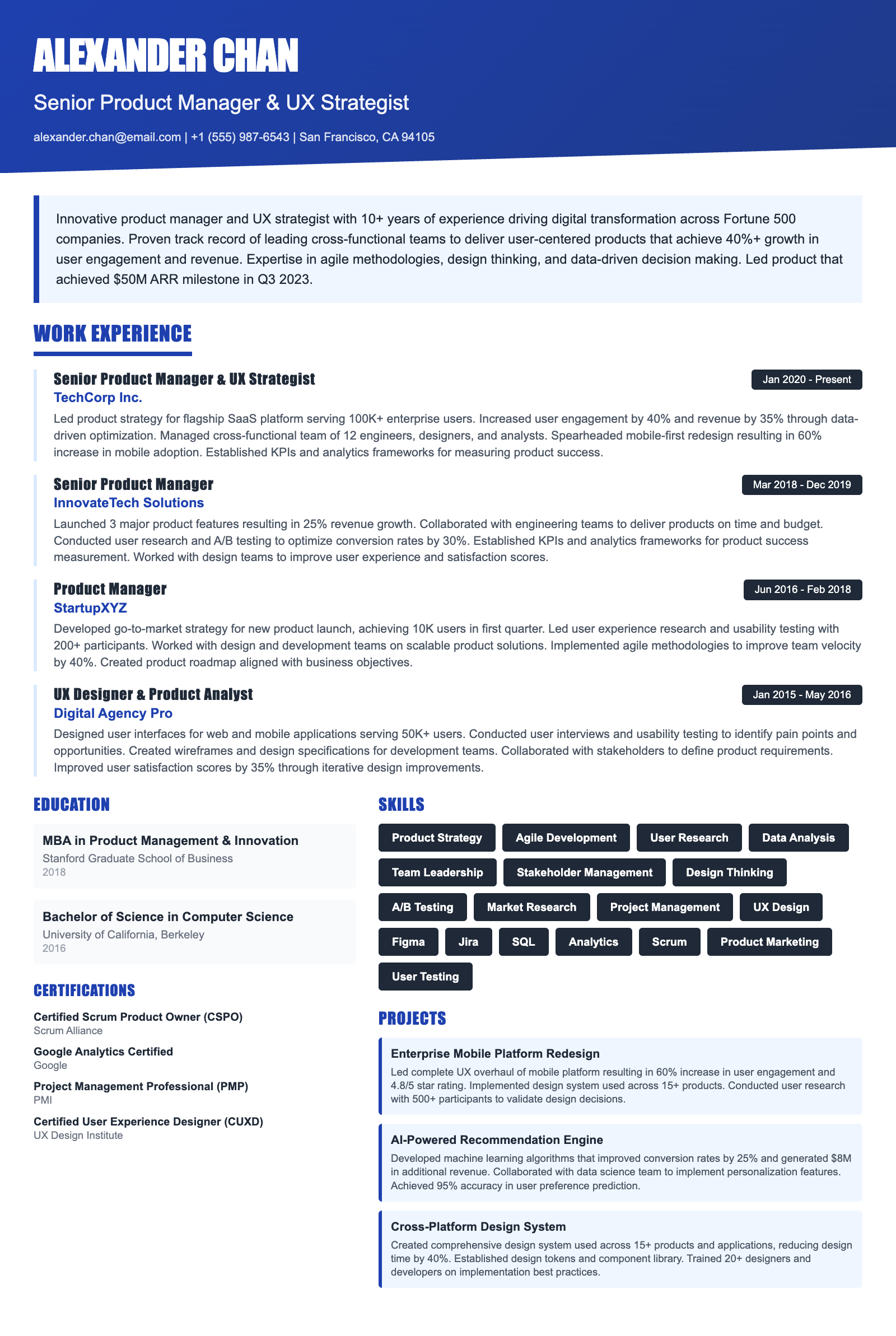
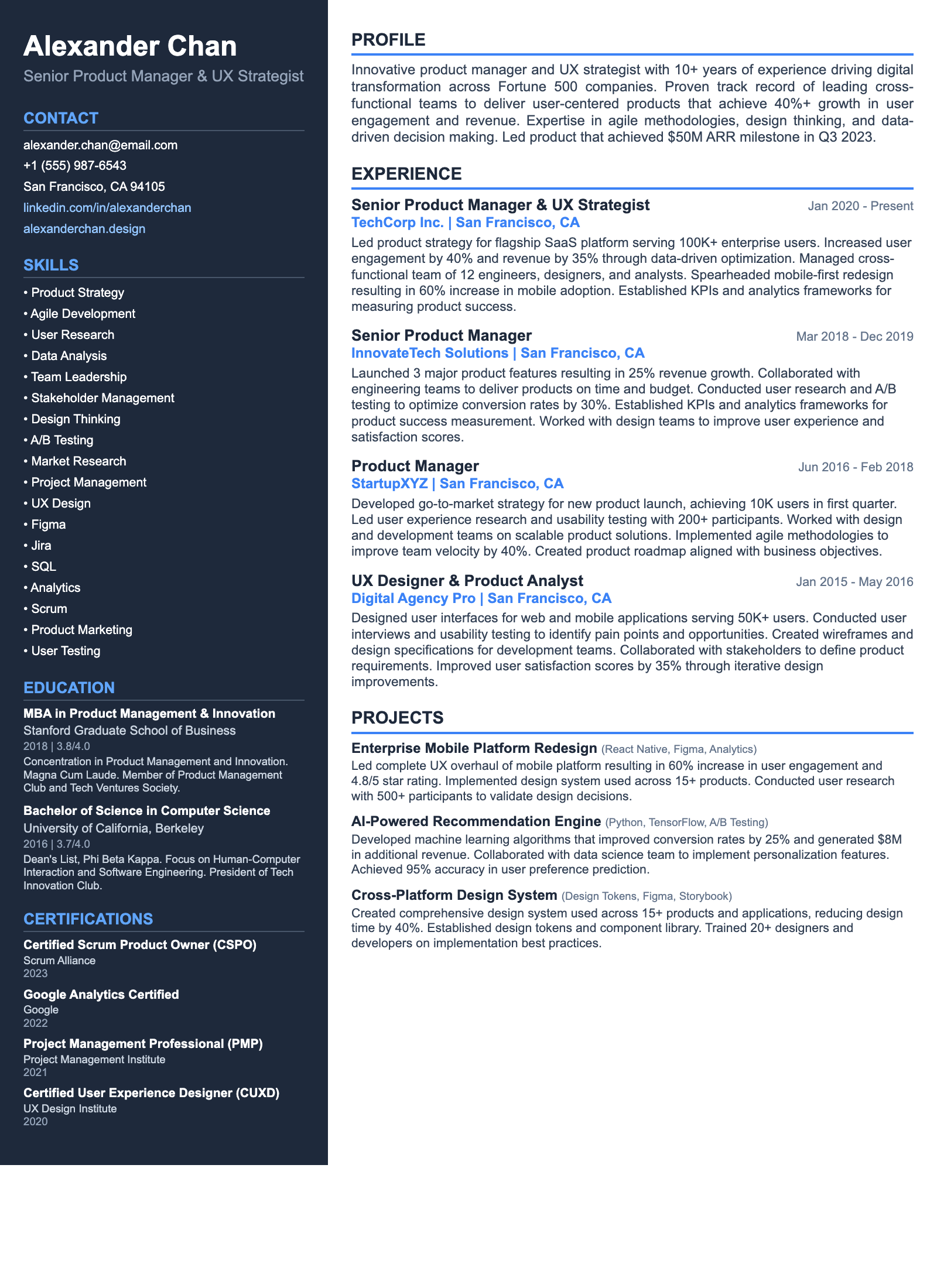
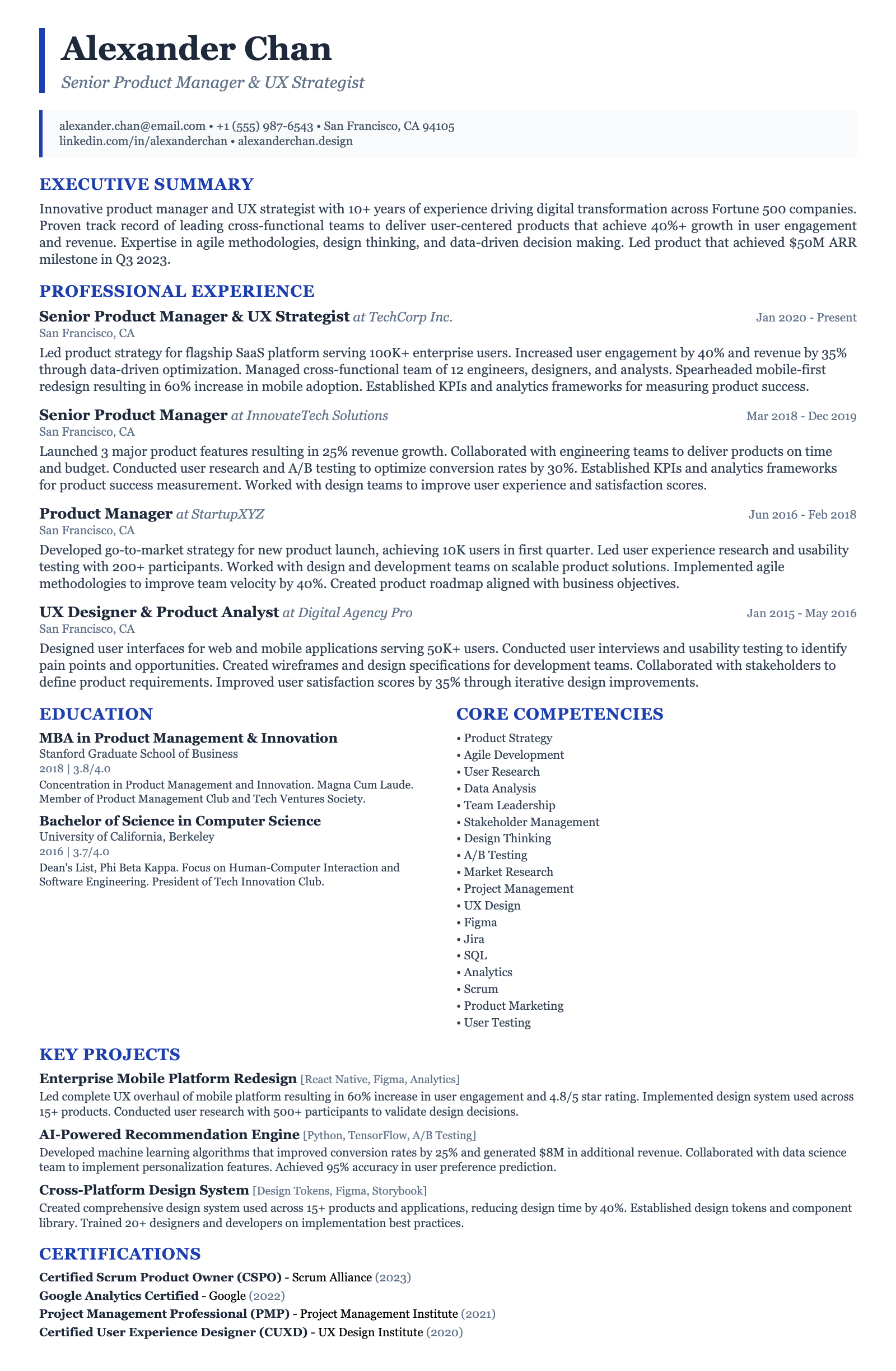
ATS-friendly templates designed specifically for Lead Manufacturing Data Scientist positions in the US market.
Frequently Asked Questions

What is the ideal length for a Lead Manufacturing Data Scientist resume?

For experienced Lead Manufacturing Data Scientists in the US market, a two-page resume is generally acceptable. Focus on the most relevant experiences and achievements, especially those demonstrating leadership and impact on manufacturing processes. If you have extensive experience (10+ years), the second page is warranted to showcase your depth and breadth. Use concise language and prioritize quantifiable results.

What key skills should I highlight on my resume?

Your resume should spotlight both your technical skills and leadership abilities. Key technical skills include proficiency in Python, R, SQL, machine learning algorithms (e.g., regression, classification, clustering), statistical modeling, data visualization (Tableau, Power BI), and cloud platforms (AWS, Azure, GCP). Leadership skills, such as project management, team leadership, communication, and problem-solving, are crucial. Demonstrate experience in applying these skills to manufacturing-specific challenges, such as predictive maintenance or yield optimization.

How can I optimize my resume for Applicant Tracking Systems (ATS)?

To improve your ATS compatibility, use a clean and simple resume format with clear headings and bullet points. Avoid tables, graphics, and unusual fonts. Incorporate relevant keywords from the job description throughout your resume, especially in the skills and experience sections. Save your resume as a PDF file, as this format is generally more ATS-friendly. Ensure proper formatting of dates and numbers.

Are certifications important for a Lead Manufacturing Data Scientist resume?

Relevant certifications can enhance your resume, especially if they demonstrate specialized knowledge or skills. Consider certifications in data science (e.g., Certified Analytics Professional), machine learning (e.g., TensorFlow Developer Certificate), cloud computing (e.g., AWS Certified Machine Learning – Specialty), or Lean Six Sigma. These certifications validate your expertise and can make you stand out to hiring managers.

What are some common resume mistakes to avoid?

Avoid generic resume templates and focus on tailoring your resume to each specific job description. Do not neglect to quantify your achievements with metrics that demonstrate the impact of your work. Refrain from listing irrelevant skills or experiences that do not align with the requirements of a Lead Manufacturing Data Scientist role. Ensure your resume is free of grammatical errors and typos.

How can I highlight my experience if I'm transitioning from a different role to Lead Manufacturing Data Scientist?

If you're transitioning into a Lead Manufacturing Data Scientist role, highlight transferable skills and experiences from your previous role. Focus on projects where you applied data analysis, problem-solving, or leadership skills, even if they were not directly related to manufacturing. Emphasize any relevant coursework, certifications, or personal projects that demonstrate your commitment to data science. Tailor your resume to showcase how your skills and experience can be applied to manufacturing challenges.

Ready to Build Your Lead Manufacturing Data Scientist Resume?

Use our AI-powered resume builder to create an ATS-optimized resume tailored for Lead Manufacturing Data Scientist positions in the US market.

Complete Lead Manufacturing Data Scientist Career Toolkit

Everything you need for your Lead Manufacturing Data Scientist job search — all in one platform.

Why choose ResumeGyani over Zety or Resume.io?

The only platform with AI mock interviews + resume builder + job search + career coaching — all in one.

See comparison

Last updated: March 2026 · Content reviewed by certified resume writers · Optimized for US job market

Lead Manufacturing Data Scientist Resume Guide (2026) | ATS-Optimized Template