
ATS-Optimized for US Market

Principal Education Data Scientist Career & Resume Guide

As a Principal Education Data Scientist, your resume needs to demonstrate a potent blend of technical expertise and leadership within the educational sector. Hiring managers seek candidates who can not only analyze complex educational data sets but also translate those insights into actionable strategies for improving student outcomes and institutional effectiveness. Your resume should clearly highlight your experience in statistical modeling, machine learning, and data visualization, showcasing projects where you've driven significant improvements in areas like student retention, personalized learning, or resource allocation. Key sections to emphasize include your technical skills (proficiency in Python with libraries like scikit-learn and TensorFlow, R, SQL, and cloud platforms like AWS or Azure), your experience leading data science teams, and specific examples of how your data-driven recommendations have positively impacted educational institutions. Stand out by quantifying your accomplishments with metrics that demonstrate the impact of your work, such as increased graduation rates or improved standardized test scores. Showcase your ability to communicate complex data insights to non-technical stakeholders, demonstrating your ability to bridge the gap between data science and educational leadership. Emphasize your understanding of educational research methodologies and ethical considerations in data usage within the education context. Showcasing your adaptability in a rapidly evolving educational technology landscape is crucial. Always tailor your resume to match the specific requirements of each job description, highlighting the skills and experiences most relevant to the employer's needs.
Average US Salary: $140k - $220k

Expert Tip: For Principal Education Data Scientist positions in the US, recruiters increasingly look for technical execution and adaptability over simple job duties. This guide is tailored to highlight these specific traits to ensure your resume stands out in the competitive Principal Education Data Scientist sector.

What US Hiring Managers Look For in a Principal Education Data Scientist Resume

When reviewing Principal Education Data Scientist candidates, recruiters and hiring managers in the US focus on a few critical areas. Making these elements clear and easy to find on your resume will improve your chances of moving to the interview stage.

  • Relevant experience and impact in Principal Education Data Scientist or closely related roles.
  • Clear, measurable achievements (metrics, scope, outcomes) rather than duties.
  • Skills and keywords that match the job description and ATS requirements.
  • Professional formatting and no spelling or grammar errors.
  • Consistency between your resume, LinkedIn, and application.
  • Proficiency in key areas such as Communication, Time Management, Industry-Standard Tools.

Essential Skills for Principal Education Data Scientist

Include these keywords in your resume to pass ATS screening and impress recruiters.

Must-Have Skills

  • CriticalCommunication
  • HighTime Management

Technical Skills

  • HighIndustry-Standard Tools
  • MediumData Analysis

Soft Skills

  • CriticalTeamwork
  • HighAdaptability
  • MediumLeadership

A Day in the Life

A Day in the Life of a Principal Data Scientist

Arrive early to review metrics or sprint progress. As a Principal Data Scientist, you lead the 9 AM stand-up, addressing blockers and setting the strategic direction for handling core responsibilities, collaborating with cross-functional teams, and driving project success within the Education team. 10 AM-1 PM is for high-impact decisions. You're architecting solutions, reviewing critical deliverables, or negotiating priorities with Education stakeholders. Afternoons involve mentorship and cross-org coordination. You're the go-to expert for handling core responsibilities, collaborating with cross-functional teams, and driving project success, ensuring the team's output aligns with company goals. You finish by finalizing quarterly roadmaps or reviewing next steps. At this level in Education, your focus shifts from individual tasks to organizational impact.

Career Progression Path

Level 1

Data Scientist I (Entry Level)

Level 2

Data Scientist II (Junior)

Level 3

Senior Data Scientist

Level 4

Lead Data Scientist

Level 5

Data Scientist Manager / Director

Interview Questions & Answers

Prepare for your Principal Education Data Scientist interview with these commonly asked questions.

Describe a time when you had to communicate a complex data analysis to a non-technical audience. What strategies did you use to ensure they understood the key insights?

Medium
Behavioral
Sample Answer
In a previous role, I presented findings on student performance disparities to a school board comprised of educators and community members. I avoided technical jargon, using clear and concise language. I created visual aids, such as charts and graphs, to illustrate the data in an accessible way. I focused on the implications of the findings for student outcomes and solicited feedback to ensure understanding. This led to the board approving a new initiative targeting at-risk students.

How would you approach building a predictive model to identify students at risk of dropping out of college?

Hard
Technical
Sample Answer
I would start by gathering relevant data, including academic records, demographic information, and financial aid status. I would then explore the data to identify potential predictors of student attrition. Using machine learning techniques like logistic regression or random forests in Python, I would build a model to predict which students are most likely to drop out. I would evaluate the model's performance using metrics like precision and recall, and I would work with stakeholders to develop interventions to support at-risk students.

Imagine you are tasked with improving the efficiency of resource allocation across a school district. How would you use data to inform your recommendations?

Medium
Situational
Sample Answer
I would begin by collecting data on resource allocation across different schools and programs, including funding, staffing, and materials. I would then analyze the data to identify areas where resources are not being used effectively. I would use statistical methods to compare the performance of schools with similar demographics but different resource allocations. Based on my findings, I would recommend reallocating resources to schools and programs that are most likely to improve student outcomes. I'd ensure I consider equity and consult with stakeholders during this process.

Describe a situation where you had to lead a team of data scientists on a challenging project. What were the key challenges, and how did you overcome them?

Medium
Behavioral
Sample Answer
I led a team tasked with developing a personalized learning platform for a large university. The key challenges included integrating data from multiple sources, dealing with inconsistent data quality, and managing conflicting priorities among team members. To overcome these challenges, I established clear communication channels, defined roles and responsibilities, and implemented a robust data governance framework. I also provided mentorship and training to help team members develop new skills.

Explain how you would design an A/B test to evaluate the effectiveness of a new online learning module.

Hard
Technical
Sample Answer
I would randomly assign students to either a control group (who receive the standard learning materials) or a treatment group (who receive the new online learning module). I would then track key metrics, such as student engagement, test scores, and completion rates, for both groups. After a set period, I would analyze the data using statistical methods to determine whether the new module had a statistically significant impact on student outcomes. I would carefully control for confounding variables and ensure that the A/B test is conducted ethically and with informed consent.

You discover a significant bias in an algorithm used to predict student loan defaults. How do you address this issue?

Medium
Situational
Sample Answer
First, I'd thoroughly investigate the source of the bias by examining the data used to train the algorithm and the algorithm's code. I'd consult with experts in fairness and ethics to understand the potential impact of the bias. Then, I'd work to mitigate the bias by retraining the algorithm with a more representative dataset or by using techniques like re-weighting or adversarial debiasing. Finally, I'd implement ongoing monitoring to detect and address any future biases that may arise, ensuring transparency and accountability in the algorithm's use.

ATS Optimization Tips

Make sure your resume passes Applicant Tracking Systems used by US employers.

Incorporate industry-specific keywords like 'learning analytics,' 'student success,' 'personalized learning,' and 'K-12 education' directly into your skills and experience sections.
Structure your resume with standard headings such as 'Summary,' 'Experience,' 'Skills,' and 'Education' to ensure the ATS can easily parse and categorize your information.
Use a reverse chronological format for your work experience, listing your most recent roles first, as this is the most common format recognized by ATS systems.
Quantify your accomplishments whenever possible, using metrics and numbers to demonstrate the impact of your work. For example, 'Improved student retention rates by 10% through predictive modeling.'
Save your resume as a PDF to preserve formatting, but ensure the text is selectable so the ATS can read it. Some ATS systems handle .docx formats well, but PDF is generally safer.
Include a skills section that lists both your hard and soft skills, using keywords from the job description. For example, 'Python, R, SQL, Machine Learning, Data Visualization, Communication, Teamwork'.
Tailor your resume to each job description by including relevant keywords and phrases. Highlight the skills and experiences that are most relevant to the specific role.
Use consistent formatting throughout your resume, including font size, spacing, and bullet point style. Inconsistent formatting can confuse the ATS and make your resume difficult to read.

Common Resume Mistakes to Avoid

Don't make these errors that get resumes rejected.

1
Failing to quantify the impact of your work. Instead of saying 'Improved student outcomes,' say 'Improved student outcomes, resulting in a 10% increase in graduation rates.'
2
Not tailoring your resume to the specific requirements of the job description. Generic resumes are less likely to be selected by ATS systems and hiring managers.
3
Neglecting to highlight your leadership experience. As a Principal Data Scientist, your ability to lead and mentor teams is crucial.
4
Omitting relevant skills or technologies. Ensure you include all the tools and techniques you're proficient in, such as Python, R, SQL, machine learning algorithms, and data visualization tools.
5
Using jargon or technical terms that are not commonly understood by hiring managers in the education sector. Communicate your ideas clearly and concisely.
6
Not proofreading your resume carefully for errors in grammar and spelling. Typos can make you look unprofessional and careless.
7
Focusing solely on technical skills and neglecting to highlight your communication and collaboration skills. The ability to communicate complex data insights to non-technical stakeholders is essential.
8
Not including projects or experiences that are directly relevant to the education sector. Highlight projects where you've worked with educational data or applied data science to solve problems in education.

Industry Outlook

The US Education sector is experiencing steady growth. Principal Data Scientists are particularly sought after, with the Bureau of Labor Statistics projecting average job growth through 2030. Peak hiring occurs in Q1 (January-March) and Q3 (August-September).

Top Hiring Companies

Industry LeadersRegional FirmsFast-Growing Companies

Recommended Resume Templates

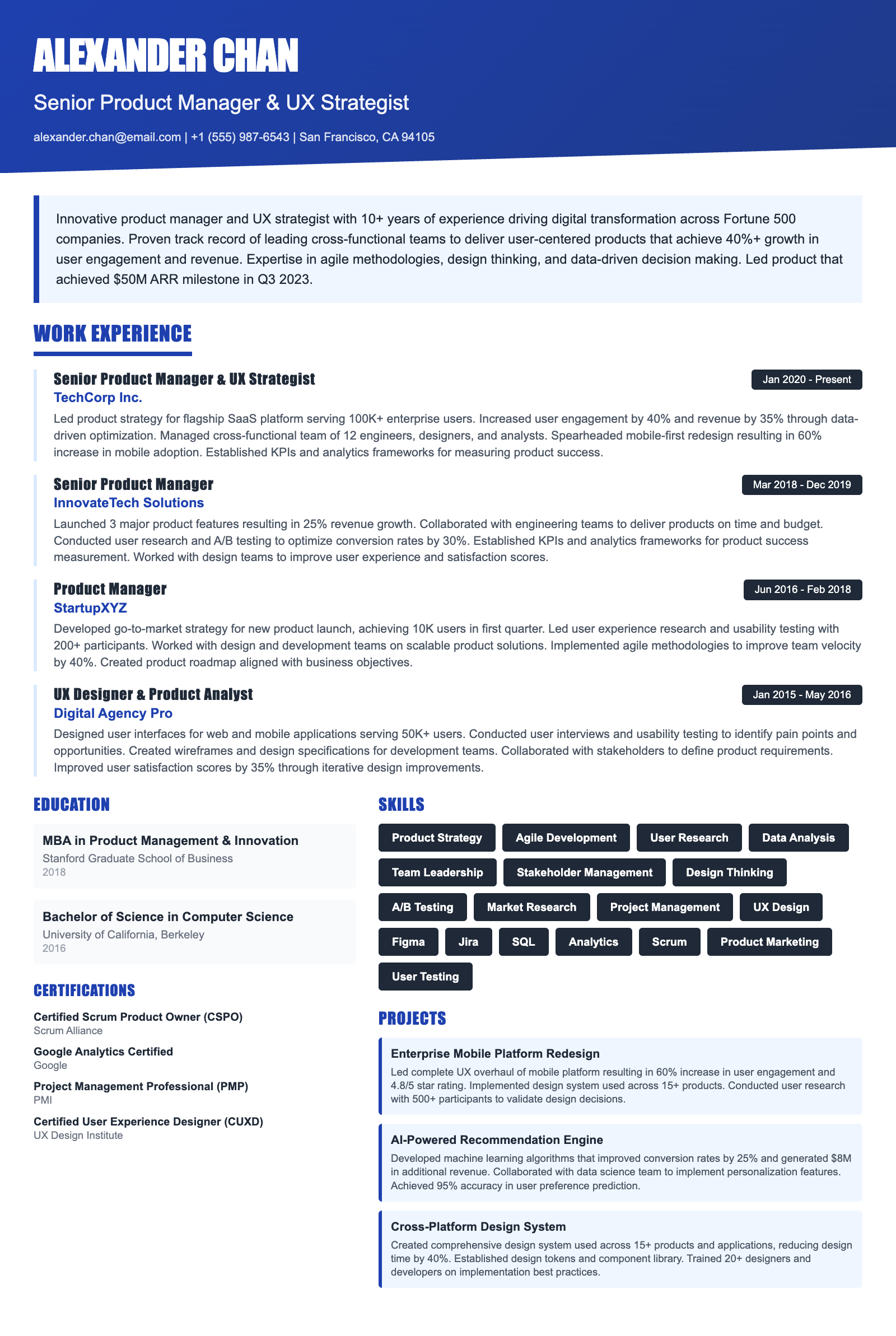
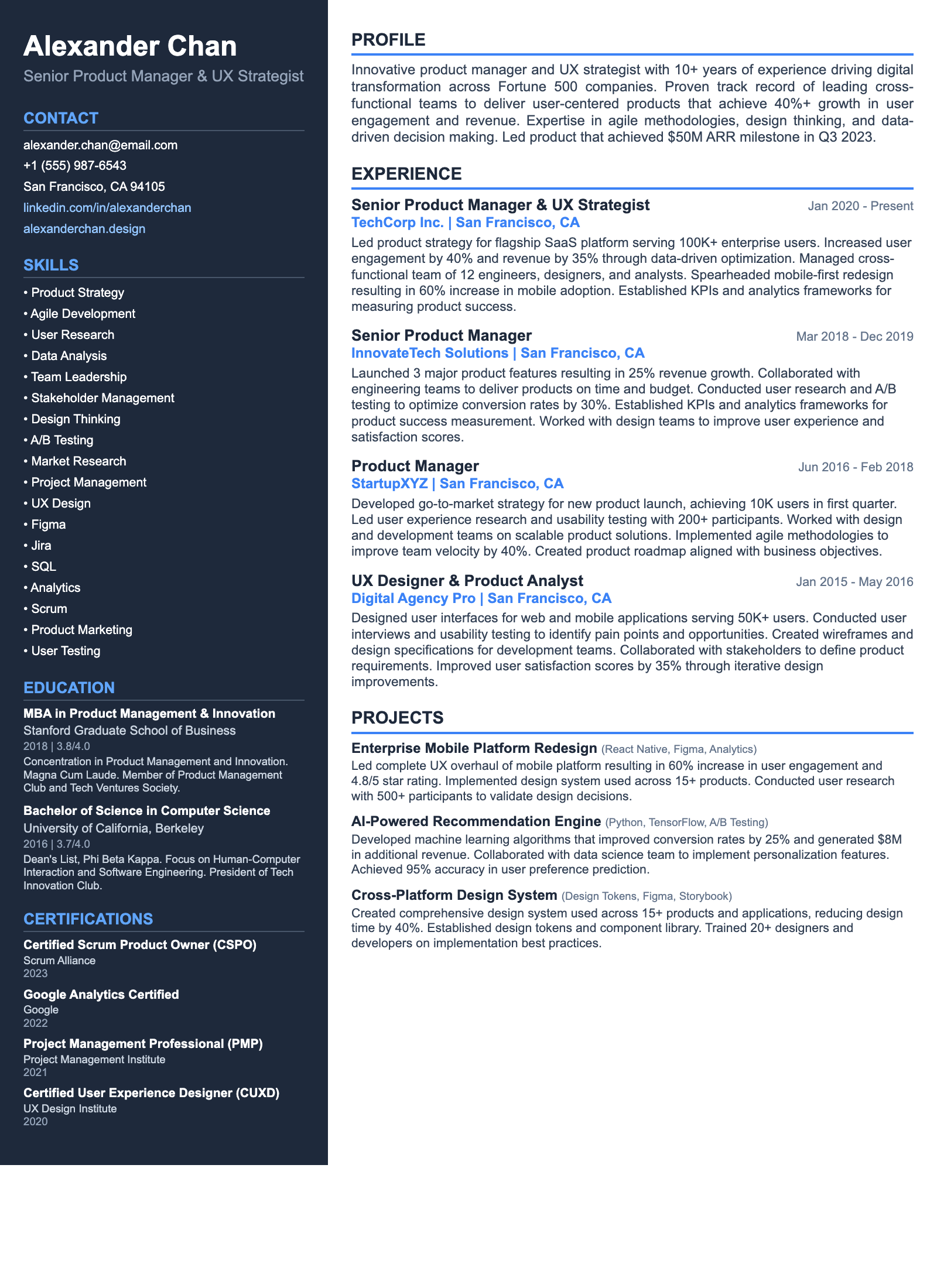
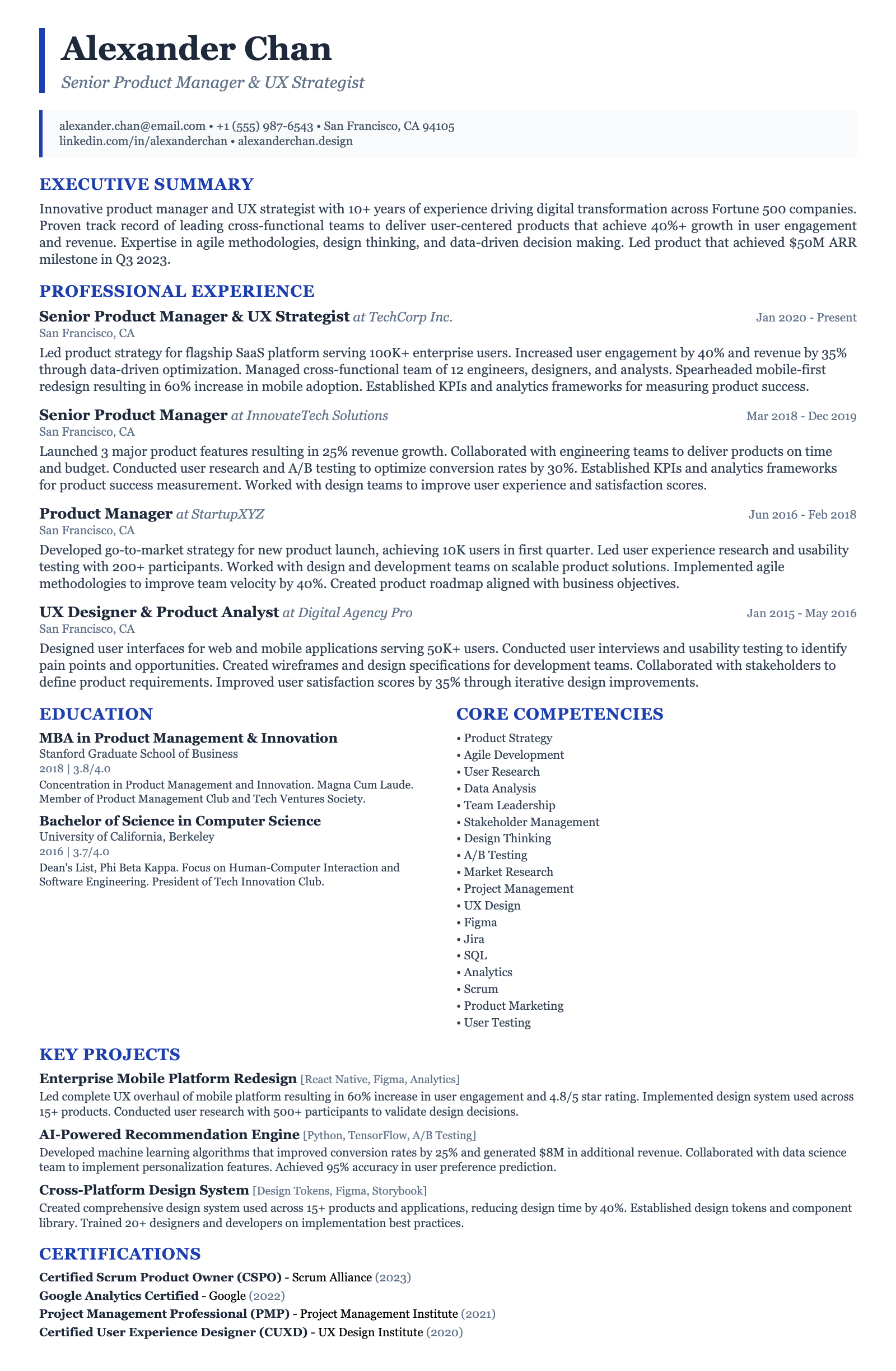
ATS-friendly templates designed specifically for Principal Education Data Scientist positions in the US market.
Frequently Asked Questions

What is the ideal length for a Principal Education Data Scientist resume?

Given the seniority of the role, a two-page resume is generally acceptable. Focus on showcasing your most impactful projects and leadership experiences. Ensure that every bullet point adds value and highlights your contributions to improving educational outcomes using tools like Tableau, Python (Pandas, NumPy, Scikit-learn), and cloud-based data warehousing solutions.

What are the most important skills to highlight on my resume?

Emphasize your expertise in statistical modeling, machine learning (especially as applied to education data), data visualization, and data mining. Demonstrate proficiency in programming languages such as Python and R, as well as experience with big data technologies like Hadoop or Spark. Highlight experience with A/B testing, experimental design, and causal inference within an educational context. Leadership experience is also vital.

How can I optimize my resume for Applicant Tracking Systems (ATS)?

Use a clean, ATS-friendly format with clear headings and bullet points. Avoid tables, images, and unusual fonts that ATS systems may not be able to parse. Include relevant keywords from the job description, such as 'educational data mining,' 'predictive modeling,' or 'learning analytics.' Tailor your resume to each specific job application.

Are certifications important for a Principal Education Data Scientist role?

While not always mandatory, certifications in areas like data science, machine learning, or cloud computing (e.g., AWS Certified Machine Learning – Specialty) can demonstrate your commitment to professional development and enhance your credibility. Certifications in data privacy and ethics (e.g., Certified Information Privacy Professional/Manager) are also valuable given the sensitivity of education data.

What are some common resume mistakes to avoid?

Avoid generic statements and focus on quantifiable achievements. Don't simply list your responsibilities; instead, highlight the impact of your work. For example, instead of saying 'Developed machine learning models,' say 'Developed machine learning models that improved student retention rates by 15% using Python and TensorFlow.' Do not neglect to showcase projects related to the education sector.

How can I transition into a Principal Education Data Scientist role from a related field?

Highlight transferable skills and experience from your previous role, such as data analysis, statistical modeling, or project management. Showcase any relevant projects you've worked on, even if they weren't specifically in the education sector. Consider taking online courses or certifications to demonstrate your commitment to learning about educational data science. Network with professionals in the field and tailor your resume to emphasize your passion for education and your ability to apply data science to improve educational outcomes using tools such as SQL and Python.

Ready to Build Your Principal Education Data Scientist Resume?

Use our AI-powered resume builder to create an ATS-optimized resume tailored for Principal Education Data Scientist positions in the US market.

Complete Principal Education Data Scientist Career Toolkit

Everything you need for your Principal Education Data Scientist job search — all in one platform.

Why choose ResumeGyani over Zety or Resume.io?

The only platform with AI mock interviews + resume builder + job search + career coaching — all in one.

See comparison

Last updated: March 2026 · Content reviewed by certified resume writers · Optimized for US job market

Principal Education Data Scientist Resume Guide (2026) | ATS-Optimized Template