
ATS-Optimized for US Market

Principal Healthcare UX Designer Resume Format — ATS-Optimized for US Healthcare

Landing a Principal Healthcare UX Designer role in the competitive US Healthcare market requires more than listing experience. This comprehensive guide provides ATS-optimized templates, real interview questions asked by top companies (Apple, Google, Airbnb), and insider tips from Healthcare hiring managers. Whether targeting Fortune 500 or fast-growing startups, our format is tailored for Principal candidates who want to stand out in 2026.
Average US Salary: $180k-$250k+

Expert Tip: For Principal Healthcare UX Designer positions in the US, recruiters increasingly look for technical execution and adaptability over simple job duties. This guide is tailored to highlight these specific traits to ensure your resume stands out in the competitive Principal Healthcare UX Designer sector.

What US Hiring Managers Look For in a Principal Healthcare UX Designer Resume

When reviewing Principal Healthcare UX Designer candidates, recruiters and hiring managers in the US focus on a few critical areas. Making these elements clear and easy to find on your resume will improve your chances of moving to the interview stage.

  • Relevant experience and impact in Principal Healthcare UX Designer or closely related roles.
  • Clear, measurable achievements (metrics, scope, outcomes) rather than duties.
  • Skills and keywords that match the job description and ATS requirements.
  • Professional formatting and no spelling or grammar errors.
  • Consistency between your resume, LinkedIn, and application.
  • Proficiency in key areas such as Figma (Advanced Prototyping), User Research Methods, Design Systems.

Essential Skills for Principal Healthcare UX Designer

Include these keywords in your resume to pass ATS screening and impress recruiters.

Must-Have Skills

  • CriticalFigma (Advanced Prototyping)
  • CriticalUser Research Methods
  • CriticalDesign Systems

Technical Skills

  • HighWireframing & Information Architecture
  • HighUsability Testing
  • HighAccessibility (WCAG 2.1)
  • MediumInteraction Design & Micro-animations
  • MediumHTML/CSS (for handoff)

Soft Skills

  • CriticalUser Empathy
  • HighStakeholder Presentation
  • HighCross-functional Collaboration

A Day in the Life

A Day in the Life of a Principal UX Designer in Healthcare

8:30 AM: review design system component requests and prioritize updates. 9:30 AM: lead design sprint kickoff with PM, engineering, and marketing. 11 AM: deep work — complex interaction design for a multi-step onboarding flow. 12:30 PM: lunch with engineering to discuss animation implementation feasibility. 2 PM: present design strategy to VP Product. 3:30 PM: mentor junior designer on user research methodology. 5 PM: review design system contributions.

Key Success Metrics: For Principal UX Designers in the US Healthcare sector, success is measured by output quality, stakeholder satisfaction, and continuous professional development.

Career Progression Path

Level 1

Junior Designer

Level 2

UX Designer

Level 3

Senior UX Designer

Level 4

Lead Designer

Level 5

Design Director

Level 6

VP Design / CDO

Interview Questions & Answers

Prepare for your Principal Healthcare UX Designer interview with these commonly asked questions.

Describe a time when you had to advocate for user-centered design principles within a healthcare organization that prioritized other factors, such as cost or regulatory compliance. How did you navigate this situation?

Medium
Behavioral
Sample Answer
In my previous role at a large hospital system, the IT department wanted to implement a new patient portal with minimal user testing due to budget constraints. I presented data from similar implementations demonstrating the long-term cost savings of proper user-centered design, including reduced support calls and increased patient adoption. I also highlighted potential compliance risks associated with a poorly designed system. I proposed a phased rollout with iterative testing and design adjustments. Eventually, I secured executive buy-in for a user-centered approach, resulting in a successful and compliant patient portal launch.

Explain your experience designing for accessibility within the healthcare context. What specific WCAG guidelines are most relevant, and how have you implemented them?

Medium
Technical
Sample Answer
Accessibility is paramount in healthcare UX. I've focused on WCAG 2.1 guidelines, particularly ensuring sufficient color contrast (1.4.3), keyboard navigation (2.1.1), and screen reader compatibility. For example, in designing a medication management app, I conducted user testing with visually impaired patients to validate the effectiveness of our screen reader integration. We also adhered to a minimum contrast ratio of 4.5:1 and provided alternative text for all images and icons. This resulted in a more inclusive and usable product for all patients.

Imagine you are tasked with improving the usability of an existing EHR system. How would you approach this project, starting with user research and ending with design recommendations?

Hard
Situational
Sample Answer
I would begin with a comprehensive user research phase, including contextual inquiry (observing users in their natural environment), user interviews with physicians, nurses, and administrative staff, and heuristic evaluations of the current system. I'd synthesize this data to identify key pain points and opportunities for improvement. Then, I'd create wireframes and prototypes to test potential design solutions with users. Finally, I'd present my findings and recommendations to stakeholders, advocating for a phased implementation of the most impactful improvements.

Describe a time you had to lead a team of designers and researchers to solve a complex UX problem in healthcare, while working under a tight deadline. How did you manage the project?

Medium
Behavioral
Sample Answer
During a project to redesign a telehealth platform, we faced a critical deadline to meet increased patient demand. I implemented Agile methodologies to break down the project into smaller, manageable sprints. I facilitated daily stand-up meetings to track progress and address roadblocks. I also prioritized tasks based on user impact and feasibility, focusing on the most critical features first. By fostering open communication and collaboration within the team, we delivered a redesigned platform on time and within budget, resulting in a significant improvement in patient satisfaction.

Walk me through your process for creating and maintaining a design system within a healthcare organization. What are the key components, and how do you ensure consistency across different products?

Hard
Technical
Sample Answer
My design system approach begins with a thorough audit of existing UI components and patterns. I then collaborate with stakeholders to define core design principles and establish a shared vocabulary. The system includes a component library, design tokens for styling, and usage guidelines. I use Figma for version control and collaboration. To ensure consistency, I conduct regular design reviews and provide training to designers and developers. I promote the design system through documentation, workshops, and a dedicated communication channel.

How do you stay up-to-date with the latest trends and best practices in healthcare UX, including regulatory changes and emerging technologies?

Easy
Behavioral
Sample Answer
I actively participate in healthcare UX communities, attend industry conferences (e.g., HIMSS), and follow leading research publications and blogs related to healthcare technology and design. I also dedicate time each week to explore new UX tools and methodologies. I closely monitor regulatory updates from agencies like the FDA and HHS to ensure my designs comply with the latest standards. I also participate in continuing education courses focused on digital health and user-centered design in healthcare.

ATS Optimization Tips

Make sure your resume passes Applicant Tracking Systems used by US employers.

Incorporate healthcare-specific keywords like 'EHR,' 'EMR,' 'HIPAA compliance,' and 'patient portal' directly into your skills and experience sections to align with industry-specific ATS parsing.
Utilize a reverse chronological format, emphasizing your most recent and relevant roles, as ATS systems prioritize the latest experience for immediate qualification.
Quantify your impact using metrics like 'reduced user error rates by 15%' or 'improved task completion time by 20%' to demonstrate tangible results that ATS algorithms recognize as valuable.
Optimize your resume for readability by using clear headings, bullet points, and concise language to ensure ATS systems can accurately extract and categorize your qualifications.
Include a dedicated 'Technical Skills' section listing Figma, User Research Methods, and HTML/CSS to increase your visibility in keyword searches performed by ATS.
Save your resume as a PDF to preserve formatting and prevent misinterpretation by ATS systems, while also ensuring it remains visually appealing to human reviewers.
Incorporate keywords related to regulatory compliance (e.g., 'WCAG 2.1,' 'ADA') to highlight your understanding of accessibility standards within the healthcare industry, crucial for ATS screening.
Tailor your resume for each application by aligning your skills and experience with the specific requirements outlined in the job description; use a tool to scan for keyword matches.

Common Resume Mistakes to Avoid

Don't make these errors that get resumes rejected.

1
Failing to quantify the impact of your design solutions on patient outcomes or healthcare efficiency; provide metrics like 'improved patient satisfaction scores by X%'.
2
Overemphasizing aesthetic design skills while neglecting the regulatory and compliance aspects of healthcare UX (e.g., HIPAA, accessibility standards).
3
Using overly technical jargon that a recruiter without a healthcare background might not understand; balance technical terms with clear explanations.
4
Not showcasing experience with specific healthcare technologies (e.g., EHR/EMR systems, telehealth platforms) that are critical to the role.
5
Focusing solely on individual tasks without demonstrating leadership or mentorship experience, which is expected of a Principal Designer.
6
Omitting a portfolio or providing a portfolio that isn't easily accessible or doesn't showcase healthcare-specific projects.
7
Neglecting to highlight experience with user research methodologies tailored to the healthcare industry (e.g., working with patients with specific health conditions).
8
Assuming all UX principles are universally applicable without recognizing the unique constraints and requirements of the healthcare domain.

Industry Outlook

UX design is mature in tech — companies now differentiate on experience quality. The emergence of AI-powered design tools (Figma AI, Galileo) is changing workflows. Companies want designers who can work with data, understand engineering constraints, and lead cross-functional teams.

Top Hiring Companies

AppleGoogleAirbnbFigmaSpotifyStripeShopifySquare

Recommended Resume Templates

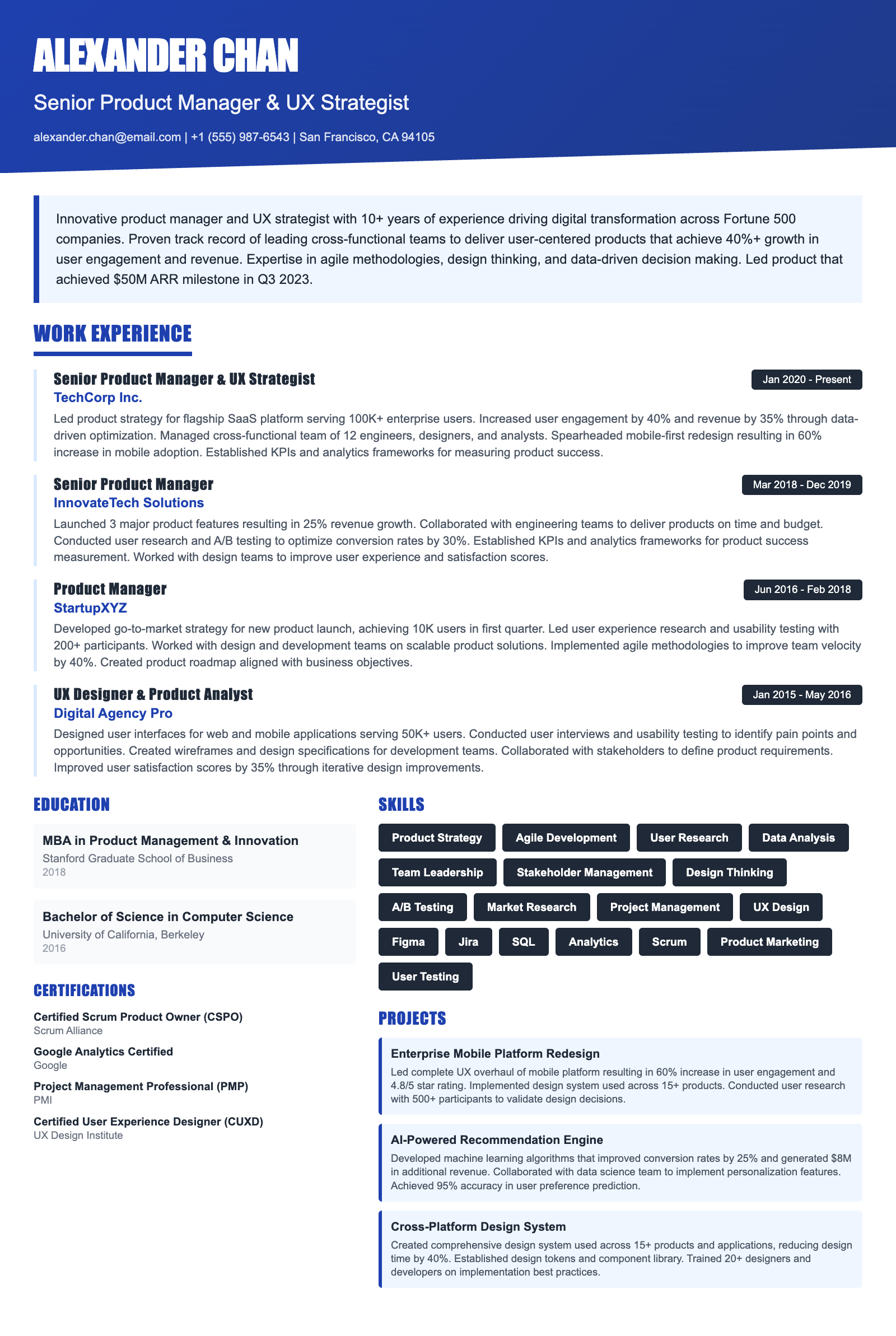
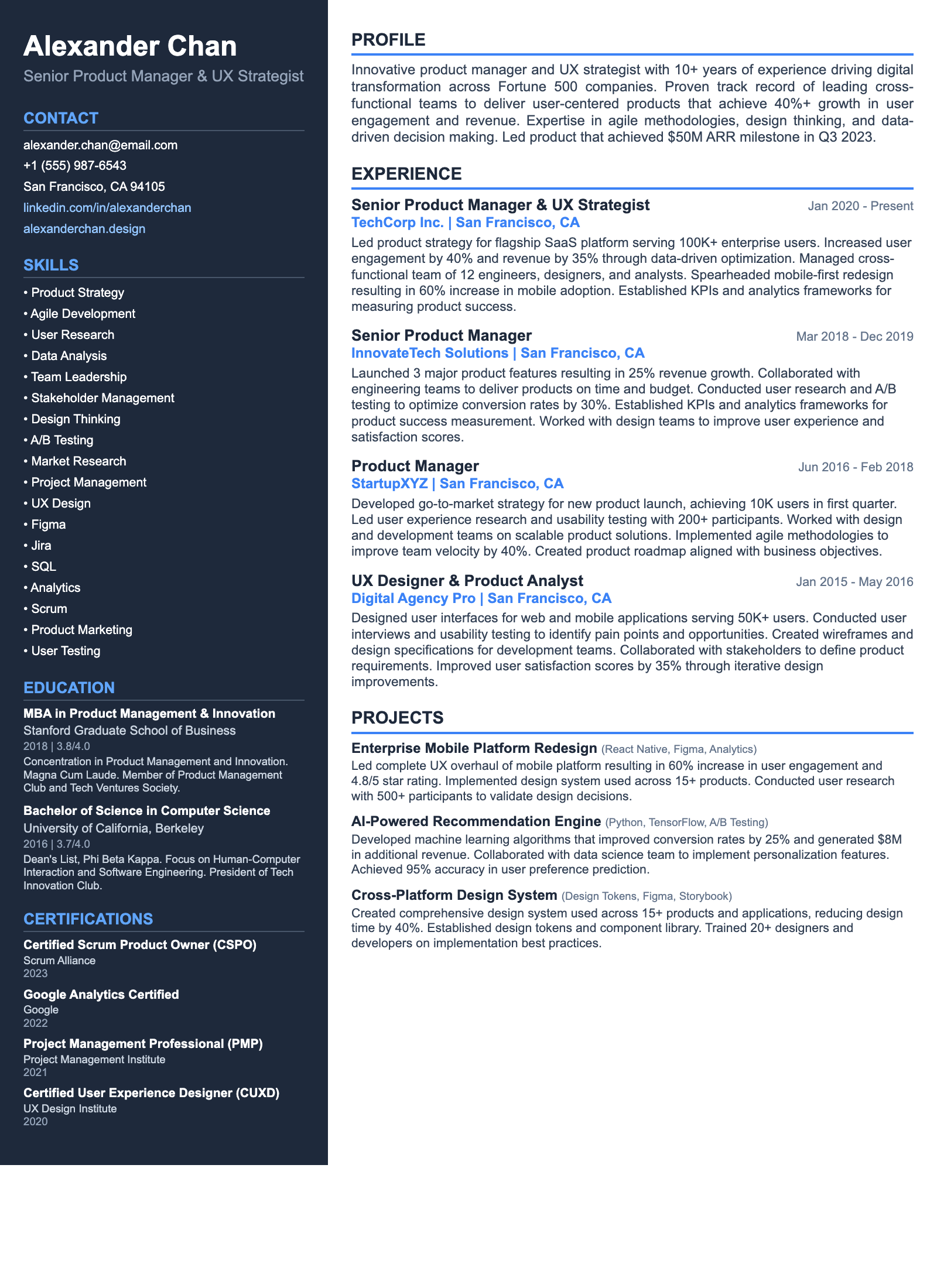
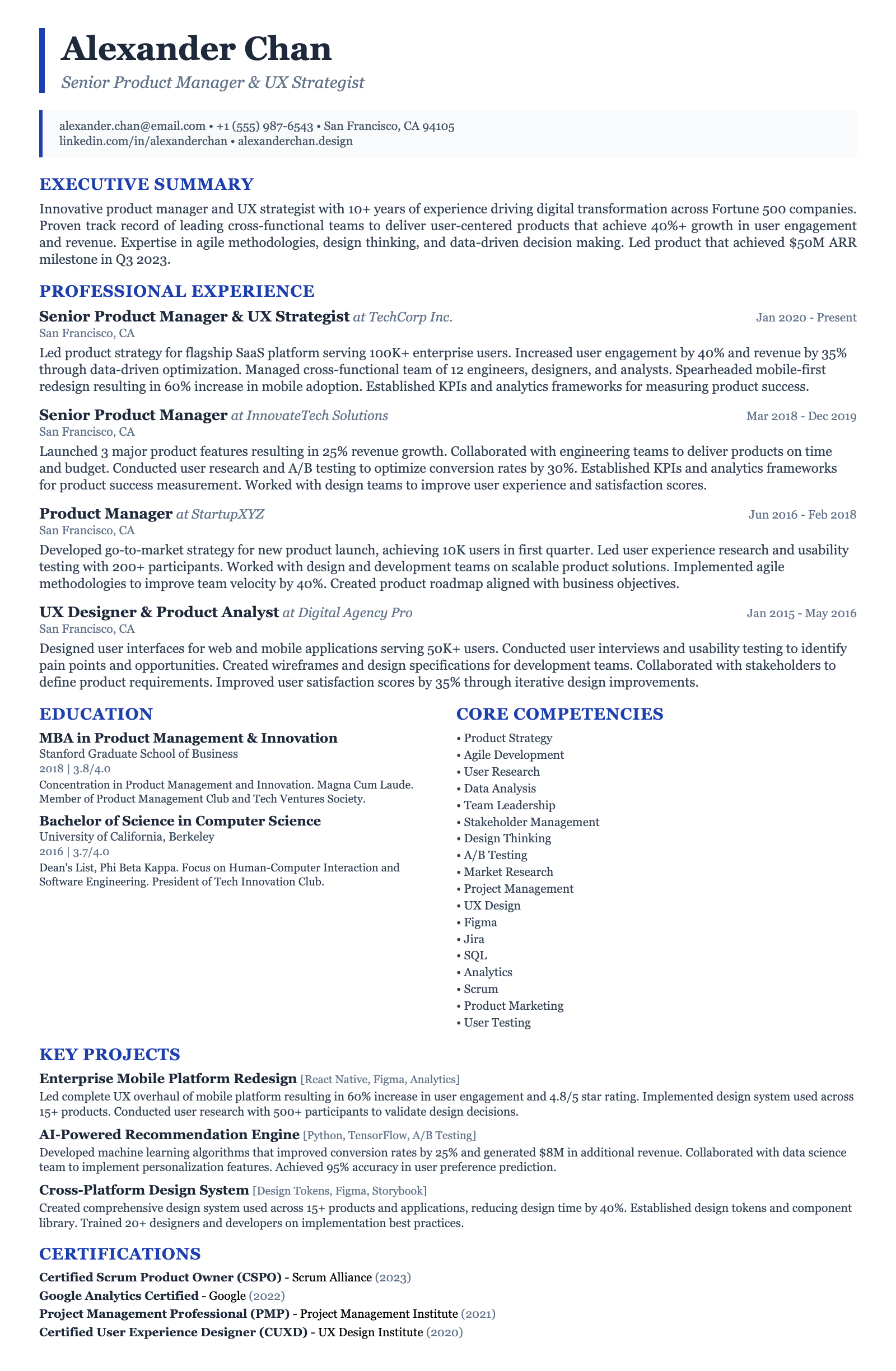
ATS-friendly templates designed specifically for Principal Healthcare UX Designer positions in the US market.
Frequently Asked Questions

What is the ideal resume length for a Principal UX Designer?

As a Principal UX Designer, 2 pages is standard. Page 1: recent impactful roles. Page 2: earlier career, certifications, and detailed technical skills. Prioritize achievements with measurable outcomes.

Should I include a photo on my US Healthcare resume?

No. US resumes should not include photos to avoid bias. Focus on skills, achievements, and quantified impact. Save your professional headshot for LinkedIn.

What's the best resume format for UX Designer positions?

Reverse-chronological is the gold standard — 90% of US recruiters prefer it. It highlights career progression. For career changers, a hybrid (combination) format that leads with a skills summary may work better.

How do I make my resume ATS-friendly for Healthcare?

Use standard section headings (Experience, Education, Skills). Avoid tables, graphics, and columns. Include exact keywords from the job description. Save as .docx or text-based PDF. Use simple fonts (Arial, Calibri). Include your job title from the posting.

What salary should I expect as a Principal UX Designer in the US?

Based on 2026 data, Principal UX Designers in US Healthcare earn $180k-$250k+ annually. SF/NYC pay 25-40% above national average. Total compensation may include RSUs, bonus (10-20%), and benefits. Use Levels.fyi and Glassdoor for specifics.

What are common mistakes on UX Designer resumes?

Showing only final polished designs without the research process (hiring managers want to see HOW you think, not just WHAT you made) Also: Not quantifying design impact ('Redesigned dashboard' vs 'Redesigned dashboard, reducing support tickets by 40%') Also: Portfolio case studies without clear problem statements, constraints, and iteration cycles

Do I need certifications for a UX Designer role?

While not always required, certifications significantly boost your resume. They demonstrate commitment and validated expertise. Top certifications for this role vary by specialization — check the job description for specific requirements.

How do I quantify achievements on my UX Designer resume?

Use the formula: Action Verb + Metric + Context. Examples: 'Reduced deployment time by 40% using CI/CD automation' or 'Managed $2M annual budget with 98% forecast accuracy'. Numbers make your resume stand out from the competition.

Ready to Build Your Principal Healthcare UX Designer Resume?

Use our AI-powered resume builder to create an ATS-optimized resume tailored for Principal Healthcare UX Designer positions in the US market.

Complete Principal Healthcare UX Designer Career Toolkit

Everything you need for your Principal Healthcare UX Designer job search — all in one platform.

Why choose ResumeGyani over Zety or Resume.io?

The only platform with AI mock interviews + resume builder + job search + career coaching — all in one.

See comparison

Last updated: March 2026 · Content reviewed by certified resume writers · Optimized for US job market