
ATS-Optimized for US Market

Principal Retail UX Designer Career & Resume Guide

As a Principal Retail UX Designer, your resume needs to showcase your ability to lead the design of user-centered experiences that drive sales and customer loyalty in the retail sector. Hiring managers seek candidates who can demonstrate a deep understanding of e-commerce platforms, in-store digital experiences, and omnichannel strategies. Your resume should clearly highlight your experience in leading UX teams, conducting user research, and translating data insights into actionable design solutions. Key sections to include are a compelling summary, a detailed work history emphasizing your leadership role in projects, a skills section listing industry-standard tools like Figma, Sketch, Adobe XD, and prototyping software, and quantifiable achievements that demonstrate your impact on key metrics such as conversion rates, customer satisfaction scores, and average order value. To stand out, showcase your experience with specific retail technologies (e.g., point-of-sale systems, mobile commerce platforms), mention any patents or publications related to UX design, and tailor your resume to each specific job application, emphasizing the skills and experiences most relevant to the role and company. Highlight your expertise in areas like information architecture, interaction design, and usability testing, and how you've used these skills to improve the overall customer journey. Quantify your accomplishments using metrics such as A/B test results, user feedback scores, and the impact of your designs on revenue. Focus on demonstrating your ability to create seamless and engaging customer experiences across all touchpoints.
Average US Salary: $140k - $220k

Expert Tip: For Principal Retail UX Designer positions in the US, recruiters increasingly look for technical execution and adaptability over simple job duties. This guide is tailored to highlight these specific traits to ensure your resume stands out in the competitive Principal Retail UX Designer sector.

What US Hiring Managers Look For in a Principal Retail UX Designer Resume

When reviewing Principal Retail UX Designer candidates, recruiters and hiring managers in the US focus on a few critical areas. Making these elements clear and easy to find on your resume will improve your chances of moving to the interview stage.

  • Relevant experience and impact in Principal Retail UX Designer or closely related roles.
  • Clear, measurable achievements (metrics, scope, outcomes) rather than duties.
  • Skills and keywords that match the job description and ATS requirements.
  • Professional formatting and no spelling or grammar errors.
  • Consistency between your resume, LinkedIn, and application.
  • Proficiency in key areas such as Communication, Time Management, Industry-Standard Tools.

Essential Skills for Principal Retail UX Designer

Include these keywords in your resume to pass ATS screening and impress recruiters.

Must-Have Skills

  • CriticalCommunication
  • HighTime Management

Technical Skills

  • HighIndustry-Standard Tools
  • MediumData Analysis

Soft Skills

  • CriticalTeamwork
  • HighAdaptability
  • MediumLeadership

A Day in the Life

A Day in the Life of a Principal UX Designer

Arrive early to review metrics or sprint progress. As a Principal UX Designer, you lead the 9 AM stand-up, addressing blockers and setting the strategic direction for handling core responsibilities, collaborating with cross-functional teams, and driving project success within the Retail team. 10 AM-1 PM is for high-impact decisions. You're architecting solutions, reviewing critical deliverables, or negotiating priorities with Retail stakeholders. Afternoons involve mentorship and cross-org coordination. You're the go-to expert for handling core responsibilities, collaborating with cross-functional teams, and driving project success, ensuring the team's output aligns with company goals. You finish by finalizing quarterly roadmaps or reviewing next steps. At this level in Retail, your focus shifts from individual tasks to organizational impact.

Career Progression Path

Level 1

UX Designer I (Entry Level)

Level 2

UX Designer II (Junior)

Level 3

Senior UX Designer

Level 4

Lead UX Designer

Level 5

UX Designer Manager / Director

Interview Questions & Answers

Prepare for your Principal Retail UX Designer interview with these commonly asked questions.

Describe a time when you had to advocate for a user-centered design approach in a retail project where stakeholders had conflicting priorities. How did you convince them, and what was the outcome?

Medium
Behavioral
Sample Answer
In a recent project, stakeholders prioritized immediate sales over long-term customer satisfaction. I conducted user research demonstrating that poor usability was leading to cart abandonment. I presented this data alongside a redesigned user flow that addressed the pain points. By showing how the improved UX would ultimately increase conversion rates and customer loyalty, I gained buy-in, and the redesigned flow significantly improved both metrics. This required strong data analysis skills, communication, and adaptability.

Walk me through your process for conducting user research in a retail setting. What methods do you typically use, and how do you ensure you're gathering actionable insights?

Medium
Technical
Sample Answer
My process involves a mix of qualitative and quantitative methods. I start with understanding business goals, then move to user interviews and surveys. I also conduct usability testing on prototypes. For retail, I leverage contextual inquiry - observing users in stores or on e-commerce platforms. To ensure actionable insights, I create user personas and journey maps, which help translate research findings into design recommendations. I use tools like UserZoom and Qualtrics for this, and prioritize data analysis to back up my claims.

Imagine you're tasked with improving the mobile shopping experience for a large retail chain. What are the first three things you would do?

Medium
Situational
Sample Answer
First, I would conduct a heuristic evaluation of the existing app and website to identify immediate usability issues. Second, I would analyze user data from Google Analytics or Adobe Analytics to understand user behavior, drop-off points, and popular features. Third, I would conduct user interviews with a representative sample of customers to gather qualitative feedback on their pain points and needs. This ensures I'm basing my recommendations on data and user insights.

Describe a time you had to manage a conflict within your UX design team. What was the situation, and how did you resolve it?

Medium
Behavioral
Sample Answer
I had a situation where two senior designers had differing opinions on a key aspect of a new mobile app design. To resolve this, I facilitated a design critique session where both designers presented their rationale, supported by user research and data. I encouraged open dialogue and constructive feedback. Ultimately, we found a solution that incorporated elements from both designs, resulting in a stronger overall product. This required strong facilitation and leadership skills.

How do you stay up-to-date with the latest trends and technologies in retail UX design?

Easy
Technical
Sample Answer
I regularly read industry publications like UX Magazine and Nielsen Norman Group articles. I also attend UX conferences and workshops to learn about new tools and techniques. Furthermore, I follow thought leaders on social media and participate in online communities. I also dedicate time to experimenting with new design tools like Figma's latest features and exploring emerging technologies like AR/VR in retail environments. Continuous learning is crucial.

Let’s say you have to redesign the user experience for an in-store kiosk that allows customers to browse products and place orders. What are some of the key design considerations you'd take into account?

Hard
Situational
Sample Answer
I'd consider the physical environment, ensuring the kiosk is accessible to users of all abilities. I'd prioritize a large, clear touchscreen interface with intuitive navigation. I’d focus on visual design that is easy to scan and understand quickly. I’d also integrate with mobile devices, allowing users to scan barcodes or use their own accounts. Finally, I’d test the kiosk with real customers in the store to gather feedback and iterate on the design. This includes both usability testing and accessibility testing.

ATS Optimization Tips

Make sure your resume passes Applicant Tracking Systems used by US employers.

Incorporate industry-specific keywords, such as 'e-commerce UX,' 'omnichannel design,' 'point-of-sale (POS) systems,' and 'mobile commerce,' throughout your resume to match what ATS systems are programmed to look for in Principal Retail UX Designer applications.
Use clear and concise section headings like 'User Experience Leadership,' 'Retail Design Projects,' and 'Technical Skills' to help the ATS easily categorize your qualifications.
Quantify your accomplishments with metrics like 'increased conversion rates by X%,' 'improved customer satisfaction scores by Y%,' and 'reduced cart abandonment by Z%' to demonstrate the impact of your designs.
List your skills using a dedicated 'Skills' section, separating them into categories like 'Design Tools' (Figma, Sketch, Adobe XD), 'Research Methods' (Usability Testing, A/B Testing), and 'Platforms' (iOS, Android, Web).
Use a chronological or combination resume format, as these are generally the most ATS-friendly and allow you to showcase your career progression.
Ensure your contact information is easily parsable by the ATS by including your name, phone number, email address, and LinkedIn profile link at the top of your resume.
Tailor your resume to each specific job description by incorporating keywords and skills mentioned in the job posting, showcasing your relevance to the role.
Save your resume as a PDF file to preserve formatting and ensure the ATS can accurately extract the information.

Common Resume Mistakes to Avoid

Don't make these errors that get resumes rejected.

1
Failing to quantify the impact of your design decisions on key retail metrics like conversion rates, average order value, or customer lifetime value.
2
Not showcasing your leadership experience and ability to mentor junior designers, a crucial aspect of a Principal role.
3
Using generic design descriptions instead of highlighting specific challenges you overcame and the innovative solutions you implemented.
4
Neglecting to mention your experience with retail-specific technologies like point-of-sale systems, mobile commerce platforms, or in-store digital experiences.
5
Overlooking the importance of accessibility in retail UX design, especially for users with disabilities.
6
Not tailoring your resume to each specific job application, focusing instead on a one-size-fits-all approach.
7
Focusing solely on aesthetics and neglecting the underlying information architecture and usability of your designs.
8
Omitting your experience with A/B testing and data analysis, crucial for optimizing retail experiences.

Industry Outlook

The US Retail sector is experiencing steady growth. Principal UX Designers are particularly sought after, with the Bureau of Labor Statistics projecting average job growth through 2030. Peak hiring occurs in Q1 (January-March) and Q3 (August-September).

Top Hiring Companies

Industry LeadersRegional FirmsFast-Growing Companies

Recommended Resume Templates

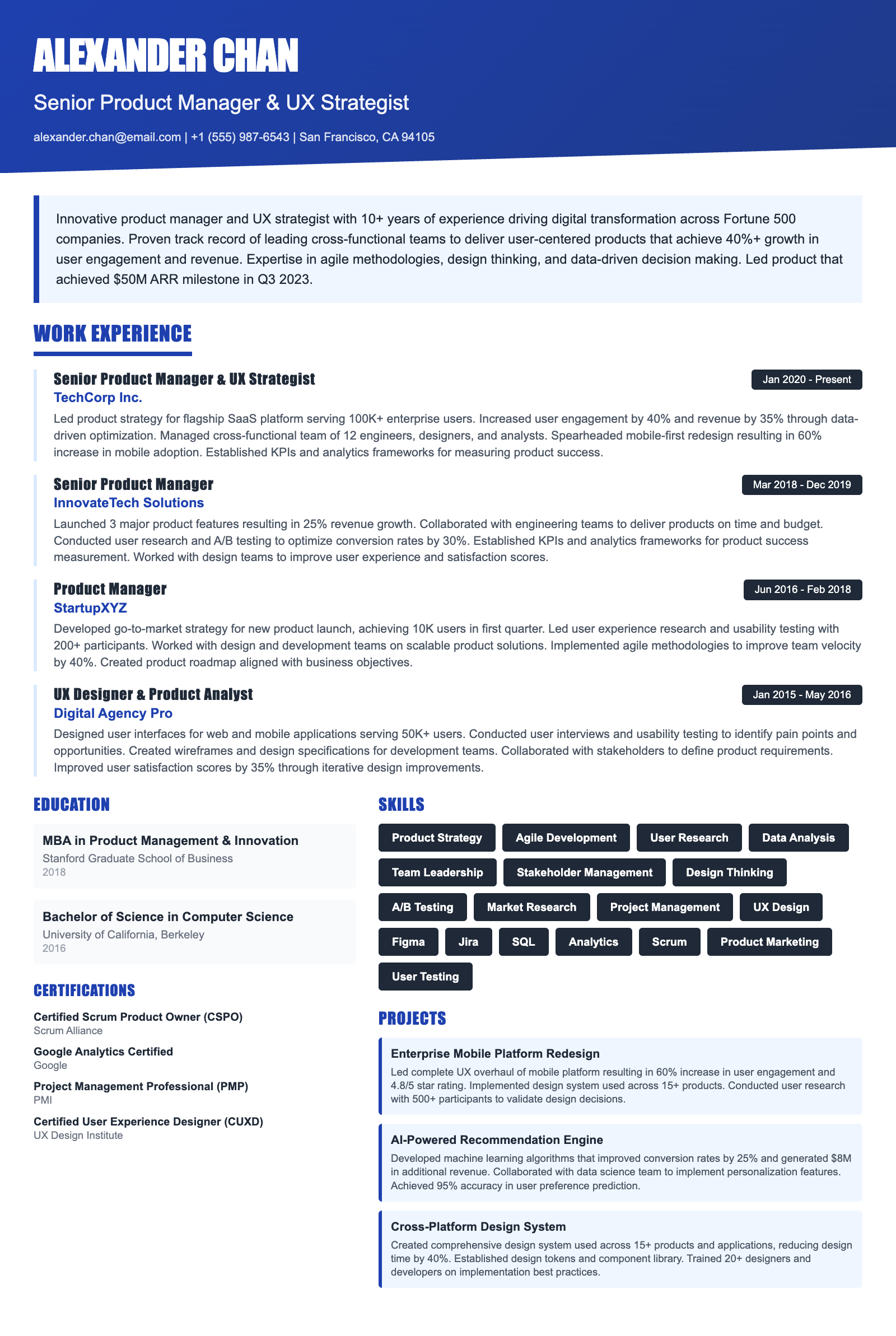
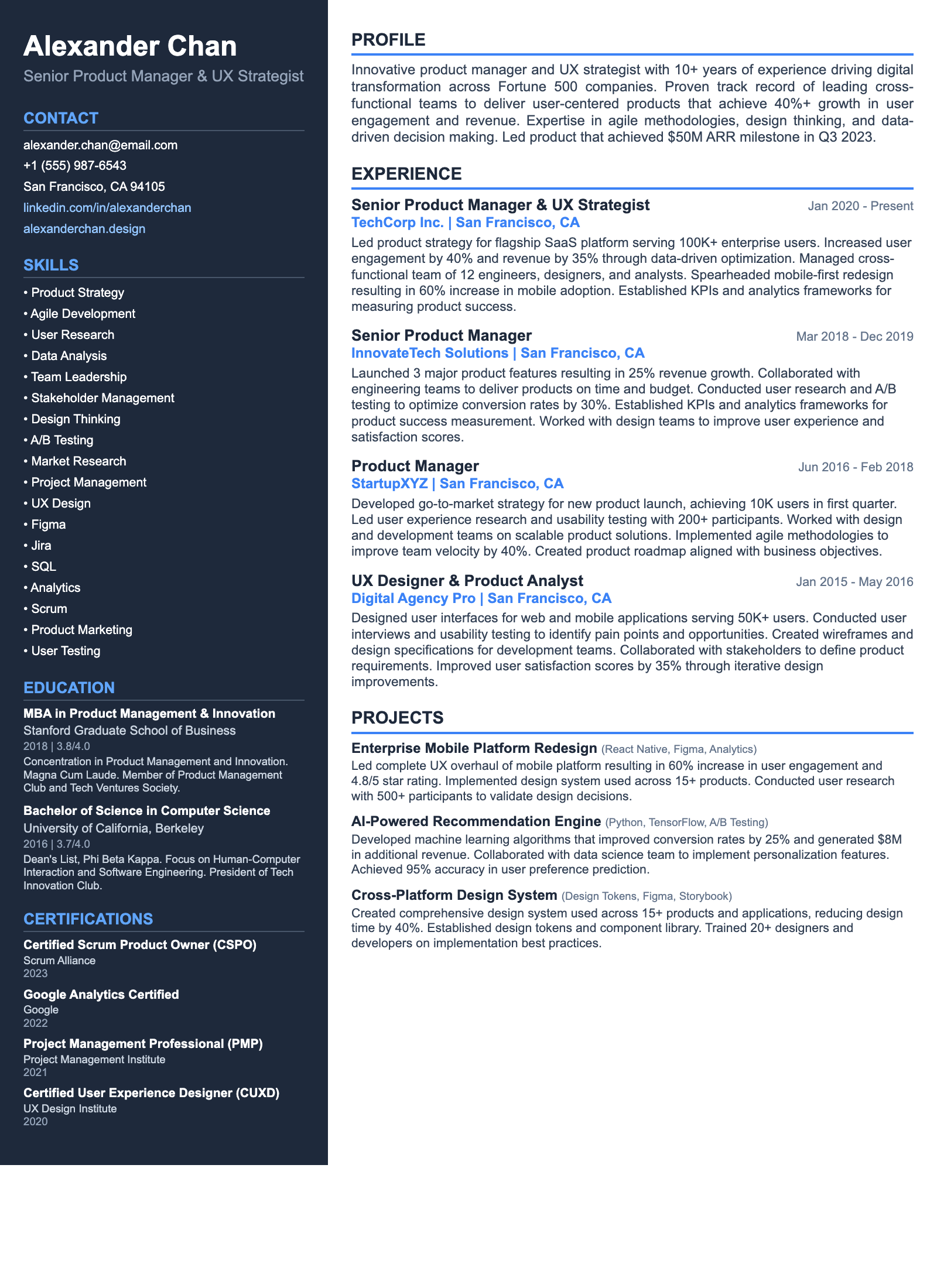
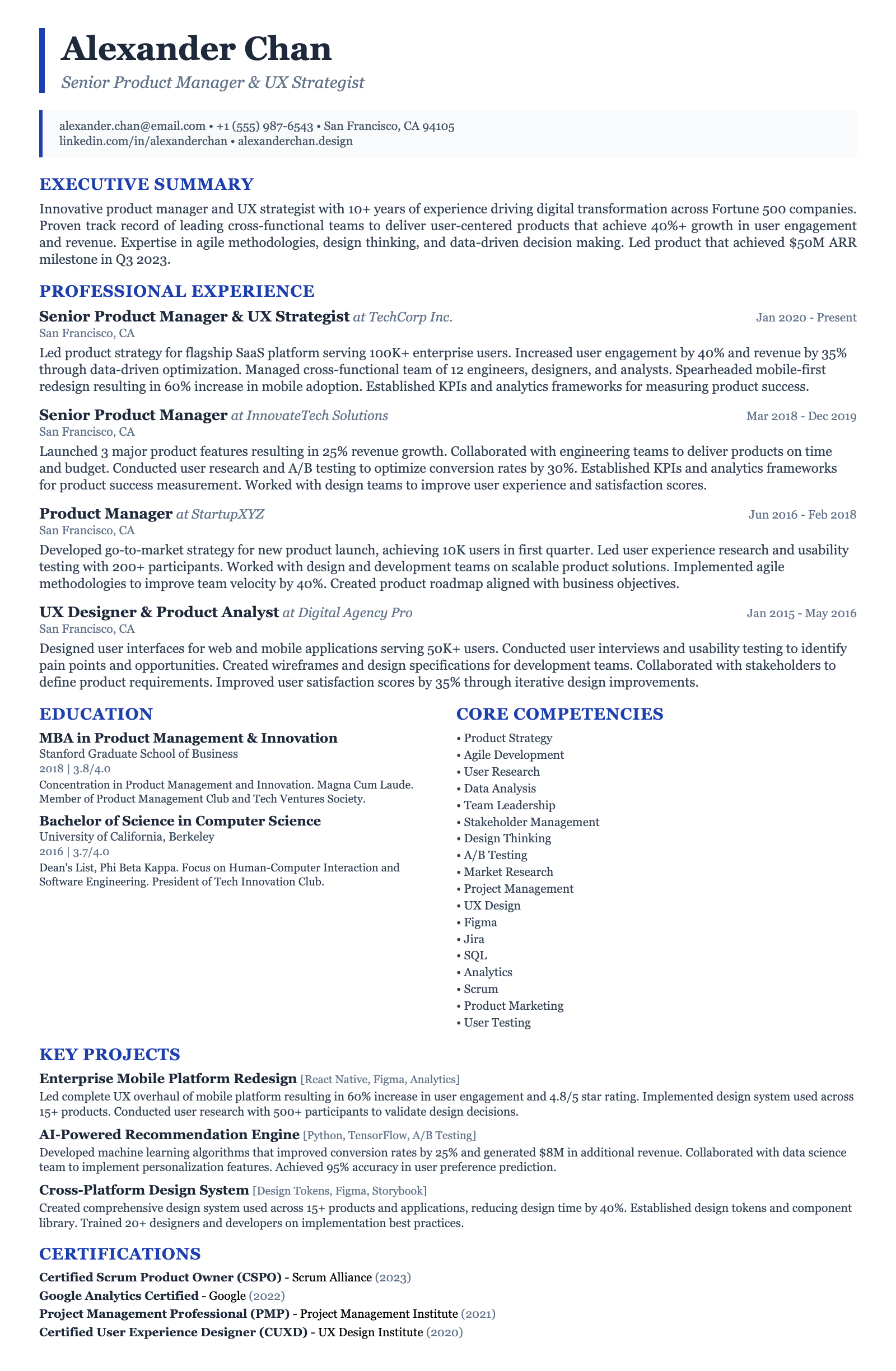
ATS-friendly templates designed specifically for Principal Retail UX Designer positions in the US market.
Frequently Asked Questions

How long should my resume be as a Principal Retail UX Designer?

Ideally, your resume should be no more than two pages. As a Principal, you likely have significant experience. Focus on the most relevant and impactful roles and projects. Quantify your achievements whenever possible, and use concise language to convey your expertise in areas like user research, interaction design, and leading UX teams. Prioritize projects that showcase your leadership and strategic thinking within the retail domain.

What key skills should I highlight on my Principal Retail UX Designer resume?

Emphasize skills crucial for retail UX, including proficiency in UX design tools such as Figma, Sketch, and Adobe XD, expertise in user research methodologies, data analysis using tools like Google Analytics or Adobe Analytics, and a strong understanding of e-commerce platforms and mobile commerce. Also, highlight your skills in leading design teams, communicating design rationale, and collaborating with cross-functional teams (e.g., product, engineering, marketing). Don't forget soft skills such as communication, leadership, and problem-solving.

How can I optimize my resume for Applicant Tracking Systems (ATS)?

Use a clean, ATS-friendly format such as a chronological or combination resume. Avoid using tables, images, or unusual fonts that can confuse the system. Incorporate relevant keywords from the job description throughout your resume, especially in the skills and experience sections. Use clear headings and subheadings to structure your resume, and submit your resume as a PDF unless otherwise specified. Tools like Jobscan can help you identify missing keywords and formatting issues.

Are certifications important for a Principal Retail UX Designer resume?

While not always required, relevant certifications can demonstrate your commitment to professional development. Consider certifications in UX design, usability testing, or agile methodologies. Highlight certifications from reputable organizations like Nielsen Norman Group or Interaction Design Foundation. Mention any workshops, courses, or professional development activities you've undertaken to stay current with industry trends and best practices in retail UX design.

What are some common resume mistakes Principal Retail UX Designers should avoid?

Avoid using generic descriptions of your responsibilities. Instead, focus on quantifying your accomplishments and highlighting the impact of your designs on key metrics such as conversion rates or customer satisfaction. Don't neglect to showcase your leadership experience and strategic thinking. Avoid using outdated design trends or including irrelevant information. Ensure your resume is free of typos and grammatical errors, as attention to detail is crucial in UX design.

How can I transition to a Principal Retail UX Designer role from a Senior UX Designer position?

Highlight your leadership experience in previous roles, even if you weren't officially a 'Principal.' Emphasize projects where you led design teams, mentored junior designers, or drove strategic design initiatives. Showcase your ability to influence stakeholders and communicate design rationale effectively. Quantify your achievements and demonstrate how your designs have positively impacted business outcomes. Tailor your resume to each specific job application, emphasizing the skills and experiences most relevant to the role and company.

Ready to Build Your Principal Retail UX Designer Resume?

Use our AI-powered resume builder to create an ATS-optimized resume tailored for Principal Retail UX Designer positions in the US market.

Complete Principal Retail UX Designer Career Toolkit

Everything you need for your Principal Retail UX Designer job search — all in one platform.

Why choose ResumeGyani over Zety or Resume.io?

The only platform with AI mock interviews + resume builder + job search + career coaching — all in one.

See comparison

Last updated: March 2026 · Content reviewed by certified resume writers · Optimized for US job market