
ATS-Optimized for US Market

Senior Hospitality Product Manager Career & Resume Guide

As a Senior Hospitality Product Manager, your resume needs to showcase your ability to drive product strategy and execution within the dynamic hospitality sector. Hiring managers seek candidates who can demonstrate a deep understanding of guest experience, operational efficiency, and technological innovation. Your resume should highlight your experience in defining product roadmaps, conducting market research, and collaborating with cross-functional teams. Key sections include a compelling summary, quantifiable achievements, relevant skills (Communication, Time Management, Industry-Standard Tools, Data Analysis, Teamwork, Adaptability, Leadership), and a detailed work history. To stand out, emphasize your experience with hospitality-specific platforms such as Amadeus, Oracle Hospitality, or Sabre. Showcase your proficiency in data analysis tools like Tableau or Google Analytics, and your ability to use data to inform product decisions. Frame your accomplishments using the STAR method (Situation, Task, Action, Result) to clearly illustrate your impact. Quantify your achievements whenever possible, such as increasing customer satisfaction scores, improving operational efficiency, or driving revenue growth. Detail your experience with agile methodologies and product management frameworks like Scrum or Kanban. Illustrate your leadership experience by describing how you’ve mentored junior product managers or led cross-functional teams to achieve product goals. Tailor your resume to each specific job application, highlighting the skills and experiences that are most relevant to the role and the company's needs. Remember to showcase your understanding of emerging trends in hospitality, such as personalization, mobile-first experiences, and the integration of AI and machine learning.
Average US Salary: $80k - $130k

Expert Tip: For Senior Hospitality Product Manager positions in the US, recruiters increasingly look for technical execution and adaptability over simple job duties. This guide is tailored to highlight these specific traits to ensure your resume stands out in the competitive Senior Hospitality Product Manager sector.

What US Hiring Managers Look For in a Senior Hospitality Product Manager Resume

When reviewing Senior Hospitality Product Manager candidates, recruiters and hiring managers in the US focus on a few critical areas. Making these elements clear and easy to find on your resume will improve your chances of moving to the interview stage.

  • Relevant experience and impact in Senior Hospitality Product Manager or closely related roles.
  • Clear, measurable achievements (metrics, scope, outcomes) rather than duties.
  • Skills and keywords that match the job description and ATS requirements.
  • Professional formatting and no spelling or grammar errors.
  • Consistency between your resume, LinkedIn, and application.
  • Proficiency in key areas such as Communication, Time Management, Industry-Standard Tools.

Essential Skills for Senior Hospitality Product Manager

Include these keywords in your resume to pass ATS screening and impress recruiters.

Must-Have Skills

  • CriticalCommunication
  • HighTime Management

Technical Skills

  • HighIndustry-Standard Tools
  • MediumData Analysis

Soft Skills

  • CriticalTeamwork
  • HighAdaptability
  • CriticalLeadership

A Day in the Life

A Day in the Life of a Senior Product Manager

Arrive early to review metrics or sprint progress. As a Senior Product Manager, you lead the 9 AM stand-up, addressing blockers and setting the strategic direction for defining product roadmaps, coordinating between engineering and design, and analyzing user feedback within the Hospitality team. 10 AM-1 PM is for high-impact decisions. You're architecting solutions, reviewing critical deliverables, or negotiating priorities with Hospitality stakeholders. Afternoons involve mentorship and cross-org coordination. You're the go-to expert for defining product roadmaps, coordinating between engineering and design, and analyzing user feedback, ensuring the team's output aligns with company goals. You finish by finalizing quarterly roadmaps or reviewing next steps. At this level in Hospitality, your focus shifts from individual tasks to organizational impact.

Career Progression Path

Level 1

Product Manager I (Entry Level)

Level 2

Product Manager II (Junior)

Level 3

Senior Product Manager

Level 4

Lead Product Manager

Level 5

Product Manager Manager / Director

Interview Questions & Answers

Prepare for your Senior Hospitality Product Manager interview with these commonly asked questions.

Describe a time you had to make a difficult product decision with limited data. What was your approach, and what was the outcome?

Medium
Situational
Sample Answer
My approach involves prioritizing assumptions, gathering quick qualitative feedback through user interviews, and running small-scale A/B tests. For example, we were considering a major UI change to our mobile app's booking flow but lacked conclusive data. I prioritized assumptions, interviewed 10 frequent users, and ran a test with a small segment. The feedback revealed usability issues we hadn't anticipated. We iterated on the design, retested, and launched a successful update that increased booking conversions by 8%.

How do you stay updated on the latest trends and technologies in the hospitality industry?

Easy
Behavioral
Sample Answer
I actively participate in industry conferences, subscribe to relevant publications like Hotel Management Magazine and Skift, and follow thought leaders on social media. I also regularly network with other product managers and attend webinars to learn about new technologies and best practices. I recently attended a webinar on AI-powered personalization in hospitality, which inspired me to explore ways to implement similar solutions in our product roadmap.

Tell me about a time you had to manage a conflict within your product team. What steps did you take to resolve it?

Medium
Behavioral
Sample Answer
I encountered a conflict between our UX and engineering teams regarding the feasibility of a new feature. The UX team wanted a complex animation, while the engineering team felt it would significantly impact performance. I facilitated a meeting where both teams could express their concerns and perspectives. We collaboratively explored alternative solutions that met both design requirements and technical constraints. By fostering open communication and finding common ground, we reached a compromise that satisfied everyone.

Describe your experience with A/B testing. Can you give an example of a successful A/B test you've run?

Technical
Technical
Sample Answer
I have extensive experience with A/B testing using tools like Optimizely and Google Optimize. For example, we tested two different headlines on our hotel booking page. Version A focused on price, while Version B highlighted amenities. Version B, highlighting amenities, resulted in a 12% increase in click-through rates and a 7% increase in bookings. This data-driven approach allowed us to optimize our booking page and drive revenue growth.

How would you approach defining the product roadmap for a new mobile app for a luxury hotel chain?

Hard
Situational
Sample Answer
I would start by conducting thorough market research to understand customer needs and identify key trends. Next, I'd collaborate with stakeholders across different departments to gather their input and align on strategic priorities. I'd then develop a high-level roadmap outlining the key features and milestones, prioritizing features that deliver the most value to customers and align with the hotel chain's brand. Finally, I'd continuously iterate on the roadmap based on user feedback and market changes.

What are some key metrics you would use to measure the success of a new feature in a hotel's loyalty program?

Technical
Technical
Sample Answer
Key metrics would include enrollment rate in the loyalty program, engagement rate with the new feature (e.g., usage frequency, time spent), redemption rate of loyalty points, customer satisfaction scores, and incremental revenue generated by loyalty members. I would also track customer retention rates and the average customer lifetime value to assess the long-term impact of the feature. Regularly monitoring these metrics enables data-driven decisions for feature optimization and program enhancements.

ATS Optimization Tips

Make sure your resume passes Applicant Tracking Systems used by US employers.

Incorporate industry-specific keywords like "PMS," "CRS," "revenue management," and "guest experience" throughout your resume to match common ATS search queries.
Use standard section headings such as "Summary," "Experience," "Skills," and "Education" to ensure the ATS can accurately parse your resume.
Quantify your achievements with metrics and data to demonstrate your impact, which can be easily extracted and analyzed by ATS.
List your skills in a dedicated skills section, using keywords that align with the job description and industry standards. Mention key tools like Salesforce Service Cloud or Medallia.
Use a chronological or combination resume format to showcase your career progression and provide a clear timeline of your experience.
Ensure your contact information is easily accessible and accurately formatted so the ATS can extract it without errors.
Tailor your resume to each specific job application by highlighting the skills and experiences that are most relevant to the role, and use keywords from the job description.
Save your resume as a PDF to preserve formatting and ensure it is readable by most ATS systems. Name the file using your name and the job title.

Common Resume Mistakes to Avoid

Don't make these errors that get resumes rejected.

1
Failing to quantify achievements with specific metrics, such as revenue growth, customer satisfaction scores, or cost savings. Instead of saying 'Improved customer experience', say 'Improved customer satisfaction scores by 15% through personalized service initiatives'.
2
Not tailoring the resume to the specific requirements of the Senior Hospitality Product Manager role, resulting in a generic and unconvincing application.
3
Using jargon or acronyms without explanation, which can confuse both hiring managers and ATS systems. For example, using 'RevPAR' without defining it.
4
Listing responsibilities instead of accomplishments, which doesn't demonstrate the impact of your work. Focus on achievements.
5
Omitting relevant skills or experience, such as experience with specific hospitality platforms or data analysis tools. Not including experience with channel management software like Siteminder.
6
Having typos or grammatical errors, which can make you appear unprofessional and detail-oriented. Proofread carefully.
7
Using an outdated or inappropriate resume format, such as one that is too creative or visually distracting. Stick to a professional, easy-to-read layout.
8
Not highlighting experience with Agile or other relevant project management methodologies. Not mentioning specific Agile frameworks used.

Industry Outlook

The US Hospitality sector is experiencing steady growth. Senior Product Managers are particularly sought after, with the Bureau of Labor Statistics projecting average job growth through 2030. Peak hiring occurs in Q1 (January-March) and Q3 (August-September).

Top Hiring Companies

Industry LeadersRegional FirmsFast-Growing Companies

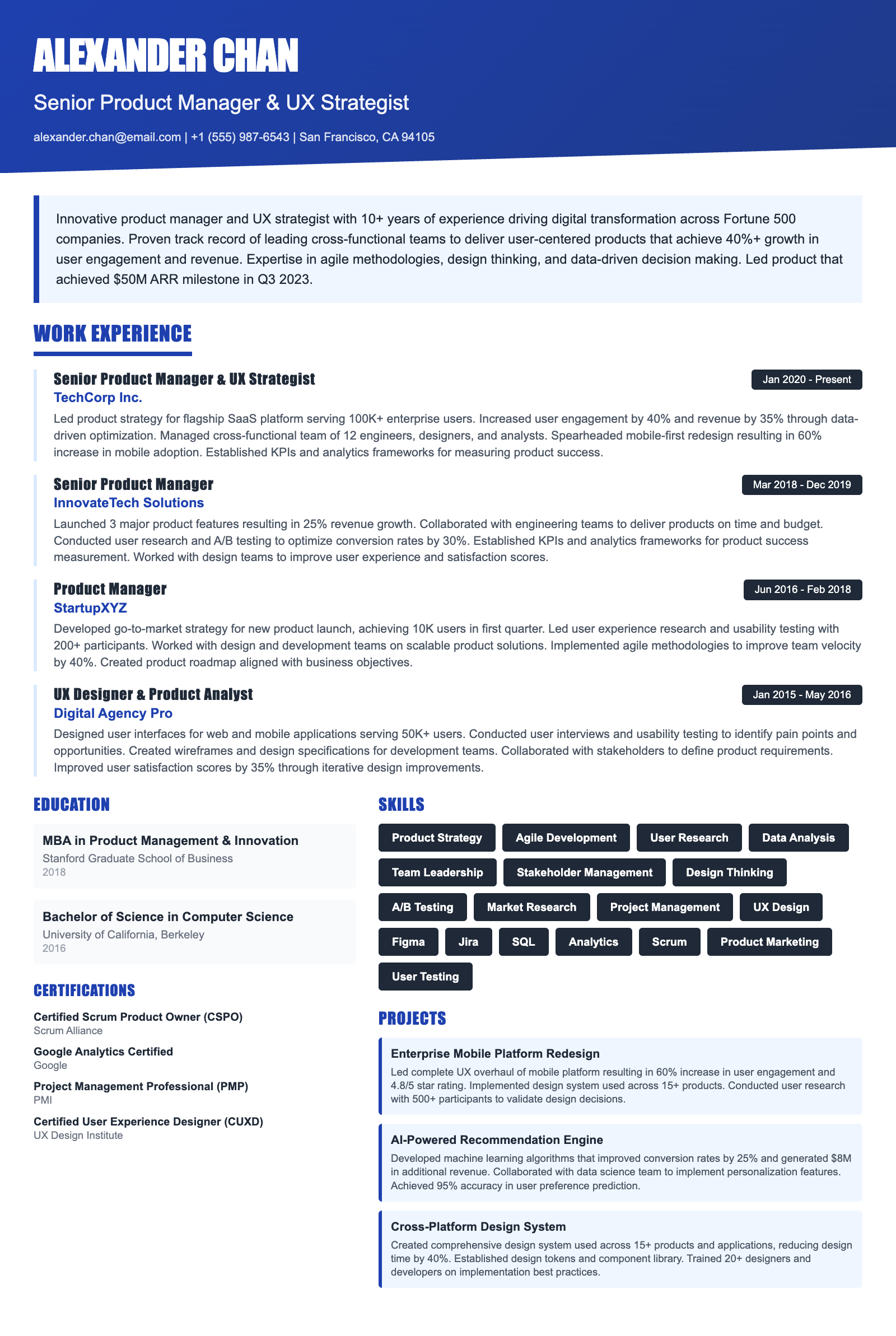
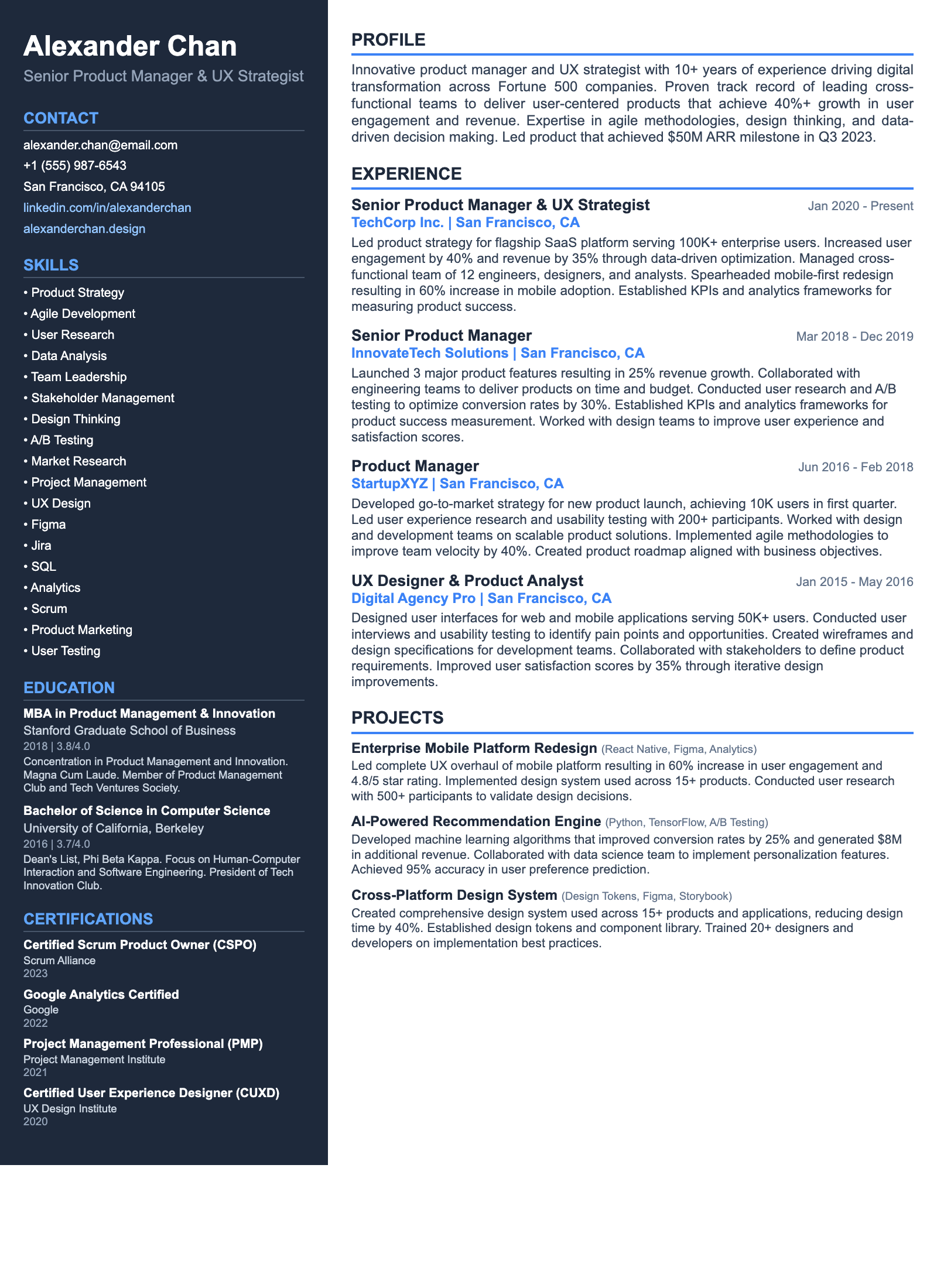
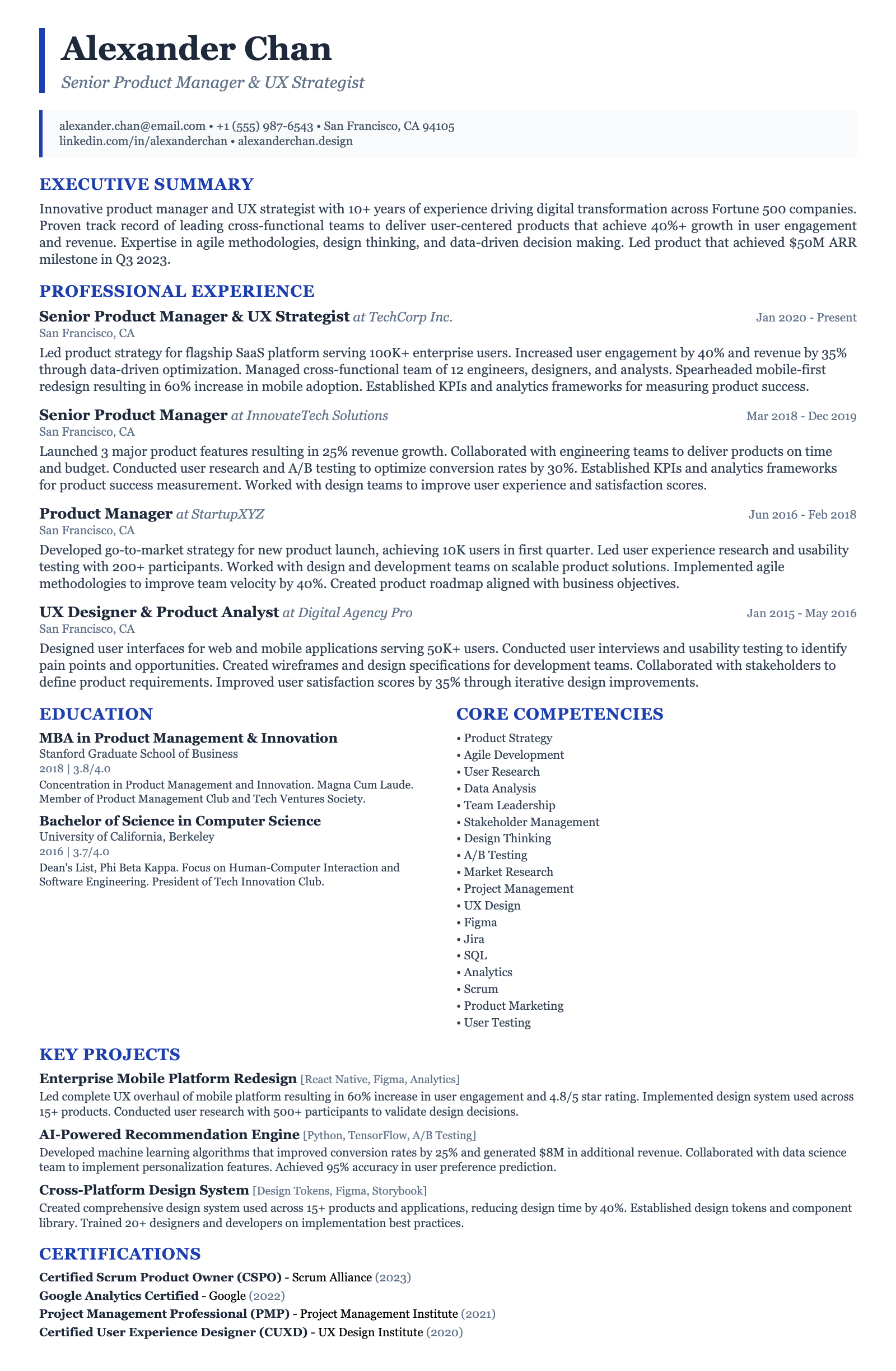
Recommended Resume Templates

ATS-friendly templates designed specifically for Senior Hospitality Product Manager positions in the US market.
Frequently Asked Questions

How long should my Senior Hospitality Product Manager resume be?

Ideally, your resume should be no more than two pages. Focus on the most relevant and impactful experiences and achievements. Given your senior-level role, showcasing a breadth of experience is important, but prioritize quality over quantity. Ensure each bullet point demonstrates how you’ve driven product success, managed teams, or utilized industry tools such as Salesforce or Sitecore to enhance customer experiences in the hospitality industry.

What key skills should I emphasize on my resume?

Highlight skills that demonstrate your ability to manage product lifecycles, lead teams, and understand the hospitality market. This includes strong analytical skills using tools like Google Analytics or Mixpanel, proficiency in product management software such as Jira or Asana, and experience with hospitality-specific platforms such as Amadeus or Sabre. Showcase your ability to translate market insights into actionable product strategies.

How can I ensure my resume is ATS-friendly?

Use a simple, clean format with clear section headings like "Summary," "Experience," "Skills," and "Education." Avoid using tables, images, or fancy fonts that can confuse ATS. Incorporate keywords from the job description throughout your resume, especially in the skills and experience sections. Save your resume as a PDF to preserve formatting while still being readable by most ATS systems. Mention specific software like Opera PMS or Infor HMS.

Are there any certifications that would strengthen my resume?

While not always required, certifications such as Certified Product Manager (CPM) or Pragmatic Marketing certifications can demonstrate your commitment to professional development. Certifications related to agile methodologies, such as Certified Scrum Product Owner (CSPO), are also valuable. Highlight any relevant training in data analysis or hospitality management as well. Consider certifications in hotel revenue management or customer experience management.

What are some common resume mistakes to avoid?

Avoid generic statements and focus on quantifiable achievements. Don't simply list your responsibilities; instead, describe how you improved product performance, increased customer satisfaction, or drove revenue growth. Also, avoid using jargon or acronyms without explanation. Ensure your resume is free of typos and grammatical errors. Not including specific project management experience with tools such as Monday.com or Trello can be a mistake.

How can I highlight my experience if I'm transitioning from a different industry?

Focus on transferable skills such as product management, data analysis, and leadership. Highlight experiences where you've successfully launched products, managed teams, or driven revenue growth, even if they weren't specifically in the hospitality industry. Demonstrate your understanding of the hospitality market through research and networking. Tailor your resume to emphasize how your skills and experience are relevant to the specific role and company. Mention any courses or bootcamps taken related to the hospitality sector.

Ready to Build Your Senior Hospitality Product Manager Resume?

Use our AI-powered resume builder to create an ATS-optimized resume tailored for Senior Hospitality Product Manager positions in the US market.

Complete Senior Hospitality Product Manager Career Toolkit

Everything you need for your Senior Hospitality Product Manager job search — all in one platform.

Why choose ResumeGyani over Zety or Resume.io?

The only platform with AI mock interviews + resume builder + job search + career coaching — all in one.

See comparison

Last updated: March 2026 · Content reviewed by certified resume writers · Optimized for US job market

Senior Hospitality Product Manager Resume Guide (2026) | ATS-Optimized Template