
ATS-Optimized for US Market

Senior Hospitality UX Designer Career & Resume Guide

As a Senior Hospitality UX Designer, your resume needs to showcase your ability to create seamless and engaging digital experiences for guests. Hiring managers in this sector prioritize candidates who understand the unique needs of hospitality users, from booking platforms to in-room entertainment systems. Highlight your proficiency with industry-standard tools like Figma, Sketch, Adobe XD, and user testing platforms such as UserTesting or Hotjar. Quantify your impact whenever possible: for example, 'Improved booking conversion rates by 15% through redesigning the user flow.' Key sections should include a compelling summary showcasing your experience and design philosophy, a detailed work history demonstrating your progression and accomplishments, a skills section that emphasizes both hard (design tools) and soft skills (communication, teamwork), and a portfolio link showcasing your best work. Stand out by demonstrating a deep understanding of hospitality trends, such as personalization, mobile-first design, and accessibility. Emphasize your experience with data-driven design, using analytics to inform design decisions and improve user satisfaction. Frame your experience around key hospitality user journeys, like reservations, check-in/check-out, in-room services, and loyalty programs. Leadership experience, particularly mentoring junior designers or leading design projects, is highly valued.
Average US Salary: $80k - $130k

Expert Tip: For Senior Hospitality UX Designer positions in the US, recruiters increasingly look for technical execution and adaptability over simple job duties. This guide is tailored to highlight these specific traits to ensure your resume stands out in the competitive Senior Hospitality UX Designer sector.

What US Hiring Managers Look For in a Senior Hospitality UX Designer Resume

When reviewing Senior Hospitality UX Designer candidates, recruiters and hiring managers in the US focus on a few critical areas. Making these elements clear and easy to find on your resume will improve your chances of moving to the interview stage.

  • Relevant experience and impact in Senior Hospitality UX Designer or closely related roles.
  • Clear, measurable achievements (metrics, scope, outcomes) rather than duties.
  • Skills and keywords that match the job description and ATS requirements.
  • Professional formatting and no spelling or grammar errors.
  • Consistency between your resume, LinkedIn, and application.
  • Proficiency in key areas such as Communication, Time Management, Industry-Standard Tools.

Essential Skills for Senior Hospitality UX Designer

Include these keywords in your resume to pass ATS screening and impress recruiters.

Must-Have Skills

  • CriticalCommunication
  • HighTime Management

Technical Skills

  • HighIndustry-Standard Tools
  • MediumData Analysis

Soft Skills

  • CriticalTeamwork
  • HighAdaptability
  • CriticalLeadership

A Day in the Life

A Day in the Life of a Senior UX Designer

Arrive early to review metrics or sprint progress. As a Senior UX Designer, you lead the 9 AM stand-up, addressing blockers and setting the strategic direction for handling core responsibilities, collaborating with cross-functional teams, and driving project success within the Hospitality team. 10 AM-1 PM is for high-impact decisions. You're architecting solutions, reviewing critical deliverables, or negotiating priorities with Hospitality stakeholders. Afternoons involve mentorship and cross-org coordination. You're the go-to expert for handling core responsibilities, collaborating with cross-functional teams, and driving project success, ensuring the team's output aligns with company goals. You finish by finalizing quarterly roadmaps or reviewing next steps. At this level in Hospitality, your focus shifts from individual tasks to organizational impact.

Career Progression Path

Level 1

UX Designer I (Entry Level)

Level 2

UX Designer II (Junior)

Level 3

Senior UX Designer

Level 4

Lead UX Designer

Level 5

UX Designer Manager / Director

Interview Questions & Answers

Prepare for your Senior Hospitality UX Designer interview with these commonly asked questions.

Describe a time when you had to make a design decision based on limited user data in a hospitality context. What was your approach?

Medium
Situational
Sample Answer
In a previous role, we were redesigning the in-room entertainment system for a hotel chain but had limited access to user data. I conducted a quick heuristic evaluation of the existing system, reviewed competitor analyses, and interviewed hotel staff to gather insights. Based on these findings, I prioritized features that enhanced user accessibility and provided personalized content recommendations. After launch, we tracked user engagement metrics and gathered feedback to iterate on the design.

How do you approach designing for accessibility in a hospitality setting, considering the diverse needs of guests?

Medium
Technical
Sample Answer
Accessibility is paramount in hospitality. I start by adhering to WCAG guidelines and conducting thorough user research to understand the specific needs of guests with disabilities. This includes considering visual, auditory, motor, and cognitive impairments. For example, I ensure sufficient color contrast, provide alternative text for images, and design intuitive navigation systems. I also advocate for inclusive design practices throughout the development process and conduct usability testing with diverse user groups.

Can you share an example of a time you had to advocate for a user-centered design approach with stakeholders who had different priorities?

Medium
Behavioral
Sample Answer
In a project to redesign a hotel's booking platform, stakeholders were primarily focused on maximizing revenue through upsells. I argued that prioritizing user experience would ultimately lead to higher conversion rates and customer loyalty. I presented data from user research that showed customers were frustrated by the overwhelming number of upsell options. By simplifying the booking process and focusing on core user needs, we saw a significant increase in completed bookings and positive customer feedback.

How do you stay up-to-date with the latest trends and technologies in hospitality UX design?

Easy
Behavioral
Sample Answer
I actively follow industry publications like Hospitality Technology and Skift. I attend relevant conferences and webinars, such as those hosted by UXPA and Nielsen Norman Group. I also participate in online communities and forums to exchange ideas and learn from other professionals. Additionally, I continuously experiment with new design tools and techniques, such as AI-powered personalization and voice-activated interfaces, to stay ahead of the curve.

Describe your experience with user testing and how you incorporate user feedback into your design process for hospitality applications.

Medium
Technical
Sample Answer
I use a variety of user testing methods, including usability testing, A/B testing, and surveys. For example, when redesigning a hotel's mobile app, we conducted usability testing with target users to identify pain points and areas for improvement. We then used A/B testing to compare different design solutions and optimize the user flow. User feedback is crucial at every stage of the design process, informing our design decisions and ensuring that we create user-friendly and effective experiences.

Imagine a scenario where a luxury hotel chain asks you to redesign their loyalty program interface to improve user engagement. What steps would you take?

Hard
Situational
Sample Answer
First, I'd conduct thorough user research to understand the current pain points and motivations of loyalty program members. This would involve surveys, interviews, and usability testing of the existing interface. Next, I'd analyze data from the hotel chain's customer relationship management (CRM) system to identify patterns and trends. Based on these insights, I'd create user personas and journey maps to guide the design process. Finally, I'd prototype and test different design solutions, iterating based on user feedback to create a seamless and engaging experience that drives loyalty and repeat business.

ATS Optimization Tips

Make sure your resume passes Applicant Tracking Systems used by US employers.

Incorporate keywords related to hospitality-specific UX design, such as 'online booking optimization,' 'guest journey mapping,' and 'in-room entertainment UX.'
Use a chronological or combination resume format to clearly showcase your career progression and relevant experience in UX design and hospitality.
List your skills using bullet points and group them into categories like 'Design Tools,' 'User Research Methods,' and 'Hospitality Systems' for easier scanning.
Include a 'Projects' section to showcase specific hospitality UX projects you've worked on, detailing your role, the challenges, and the outcomes.
Use standard section headings like 'Summary,' 'Experience,' 'Skills,' and 'Education' to help ATS systems correctly parse your resume.
When describing your experience, quantify your achievements with metrics like 'increased user engagement by X%' or 'improved conversion rates by Y%.'
Save your resume as a PDF unless the job posting specifically requests a different format, as PDFs generally maintain formatting across different systems.
Make sure to include specific technologies and software, such as Sketch, Figma, Adobe XD, Google Analytics, and UserTesting, as ATS often searches for these.

Common Resume Mistakes to Avoid

Don't make these errors that get resumes rejected.

1
Failing to quantify the impact of your design solutions with metrics specific to the hospitality industry (e.g., increased booking conversion, improved guest satisfaction scores).
2
Not tailoring your resume to highlight your experience with specific hospitality user journeys like online booking, check-in/check-out, or in-room services.
3
Omitting projects that showcase your understanding of hospitality-specific design challenges, such as creating accessible interfaces for diverse guest demographics.
4
Neglecting to showcase your understanding of current hospitality technology trends, such as mobile-first design, personalization, and voice-activated interfaces.
5
Focusing solely on visual design without emphasizing your understanding of user research and data analysis to inform design decisions.
6
Not including a link to a portfolio showcasing your best hospitality UX design work, including case studies and user testing results.
7
Using generic descriptions of your responsibilities instead of highlighting your specific contributions and accomplishments on hospitality projects.
8
Not mentioning experience with industry-specific software or platforms used in hospitality settings, such as property management systems or online travel agencies.

Industry Outlook

The US Hospitality sector is experiencing steady growth. Senior UX Designers are particularly sought after, with the Bureau of Labor Statistics projecting average job growth through 2030. Peak hiring occurs in Q1 (January-March) and Q3 (August-September).

Top Hiring Companies

Industry LeadersRegional FirmsFast-Growing Companies

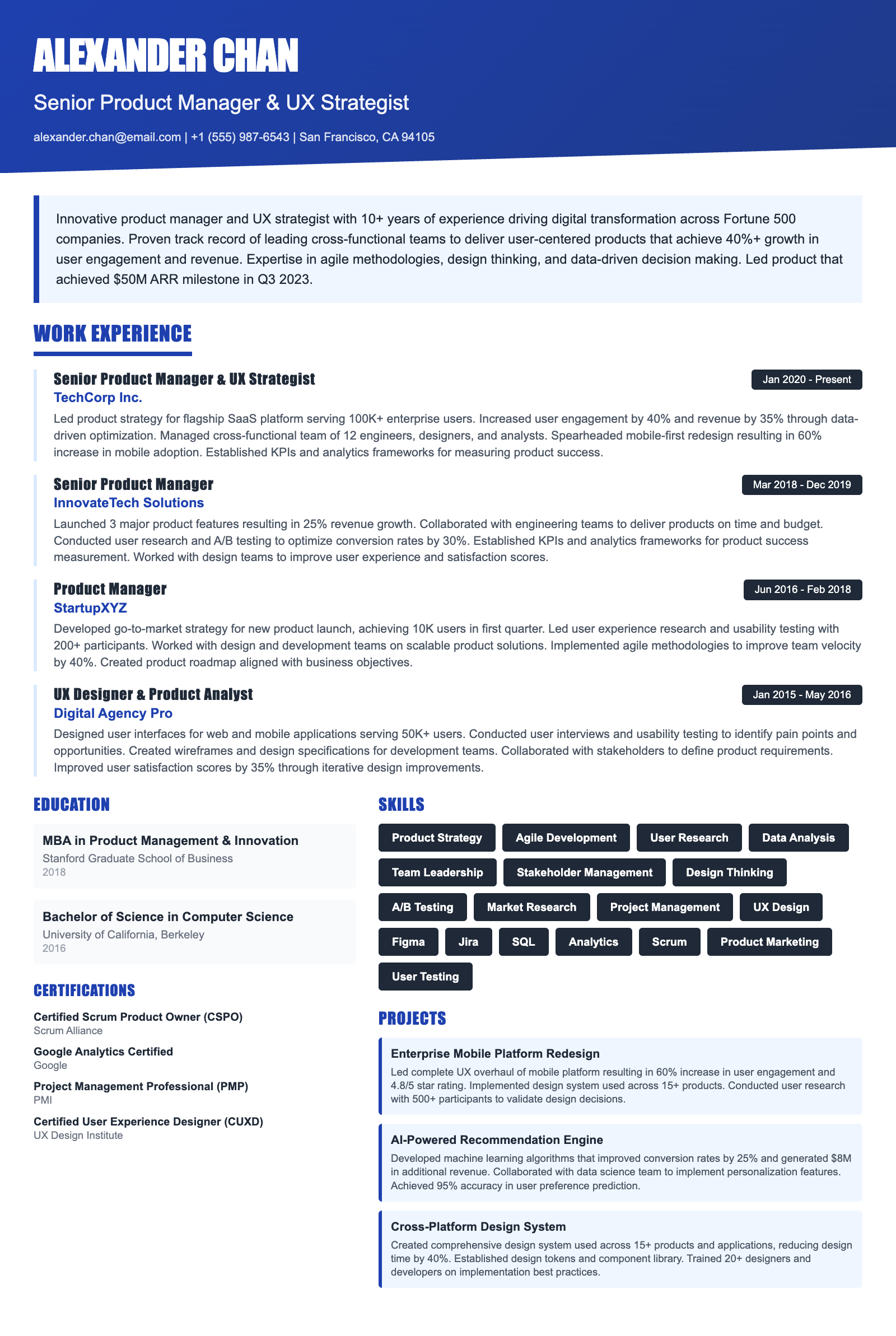
Recommended Resume Templates

ATS-friendly templates designed specifically for Senior Hospitality UX Designer positions in the US market.
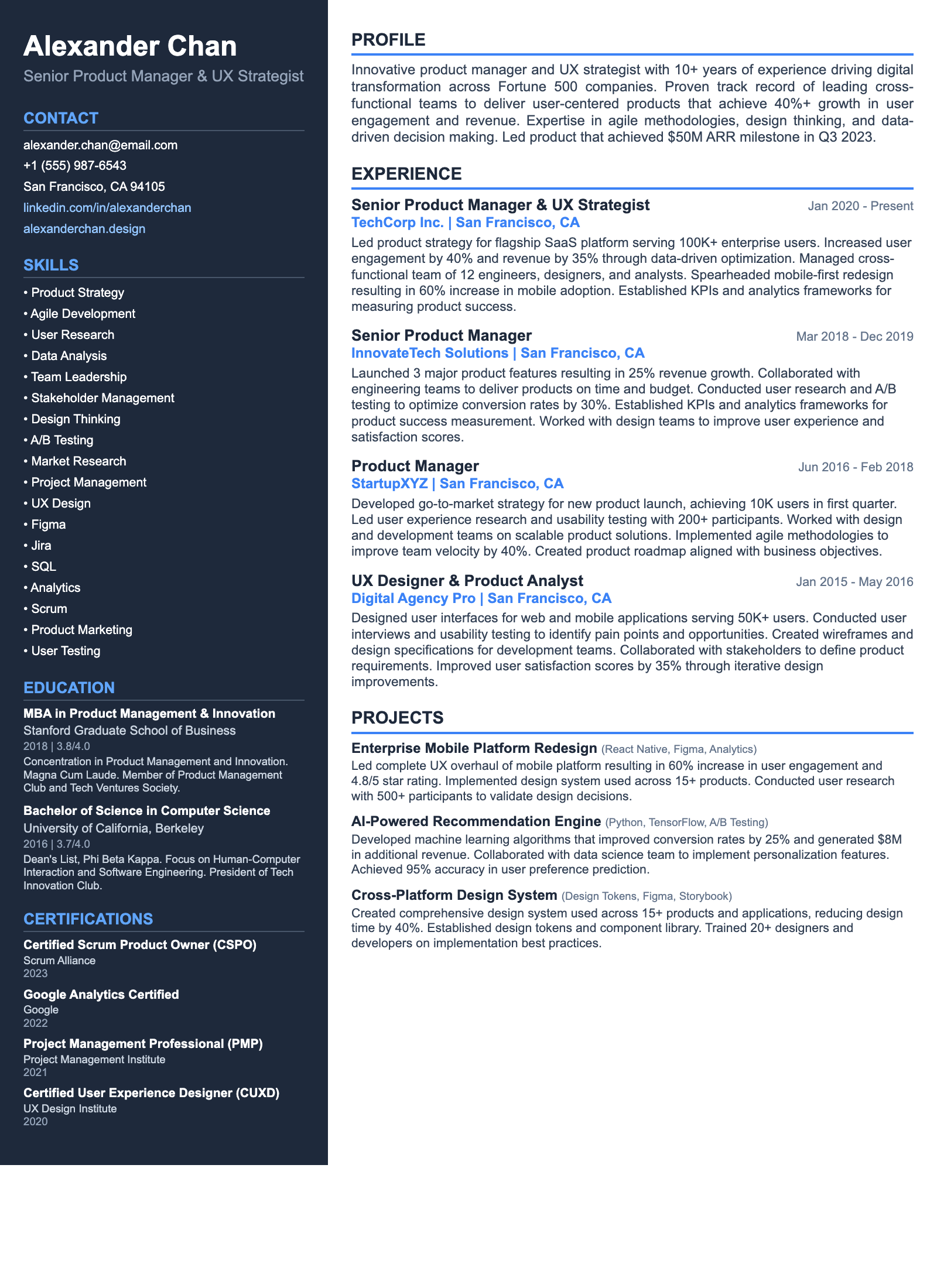
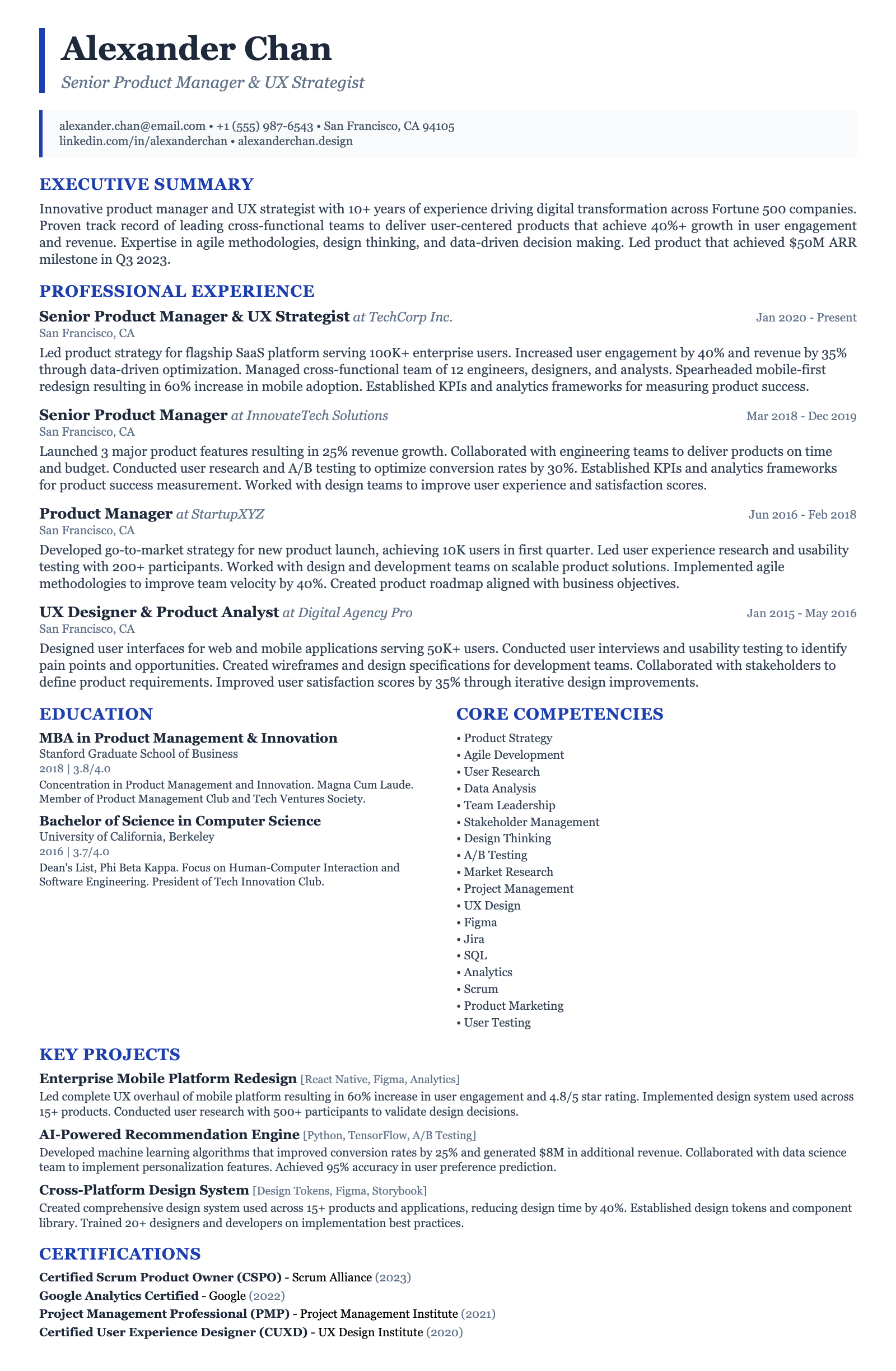
Frequently Asked Questions

What is the ideal length for a Senior Hospitality UX Designer resume?

For a Senior Hospitality UX Designer with significant experience, a two-page resume is generally acceptable. Ensure every piece of information included is relevant and impactful. Focus on quantifying your accomplishments and highlighting projects that directly demonstrate your ability to improve user experiences in hospitality settings using tools like Figma and Adobe Analytics.

What key skills should I highlight on my resume?

Emphasize skills crucial for hospitality UX, including user research, information architecture, interaction design, usability testing, prototyping, and visual design. Proficiency in design software (Sketch, Figma, Adobe XD), user testing platforms (UserTesting, Hotjar), and data analysis tools (Google Analytics) is essential. Soft skills like communication, teamwork, and problem-solving are equally important.

How can I optimize my resume for Applicant Tracking Systems (ATS)?

Use a clean, ATS-friendly format. Avoid tables, images, and unusual fonts. Incorporate relevant keywords from job descriptions, especially in your skills and experience sections. Submit your resume as a .doc or .pdf file, depending on the application instructions. Tools like Jobscan can help you assess your resume's ATS compatibility.

Are certifications important for a Senior Hospitality UX Designer?

While not always mandatory, certifications related to UX design, usability, or accessibility can demonstrate your commitment to professional development. Consider certifications from organizations like Nielsen Norman Group or Interaction Design Foundation. Highlight any specific training you've undertaken in hospitality-related UX design principles.

What are some common resume mistakes to avoid?

Avoid generic resumes that don't highlight your hospitality-specific experience. Don't neglect to quantify your achievements, for example, by specifying how your designs improved conversion rates or user satisfaction scores. Proofread carefully to eliminate typos and grammatical errors. Ensure your portfolio is up-to-date and showcases your best work.

How can I showcase a career transition into Hospitality UX Design on my resume?

If transitioning from another field, emphasize transferable skills like user research, data analysis, and problem-solving. Highlight any relevant projects or experiences, even if they weren't directly in hospitality. Consider taking online courses or workshops to demonstrate your commitment to learning hospitality UX design principles. Tailor your resume to highlight your understanding of the unique needs of hospitality users.

Ready to Build Your Senior Hospitality UX Designer Resume?

Use our AI-powered resume builder to create an ATS-optimized resume tailored for Senior Hospitality UX Designer positions in the US market.

Complete Senior Hospitality UX Designer Career Toolkit

Everything you need for your Senior Hospitality UX Designer job search — all in one platform.

Why choose ResumeGyani over Zety or Resume.io?

The only platform with AI mock interviews + resume builder + job search + career coaching — all in one.

See comparison

Last updated: March 2026 · Content reviewed by certified resume writers · Optimized for US job market

Senior Hospitality UX Designer Resume Guide (2026) | ATS-Optimized Template