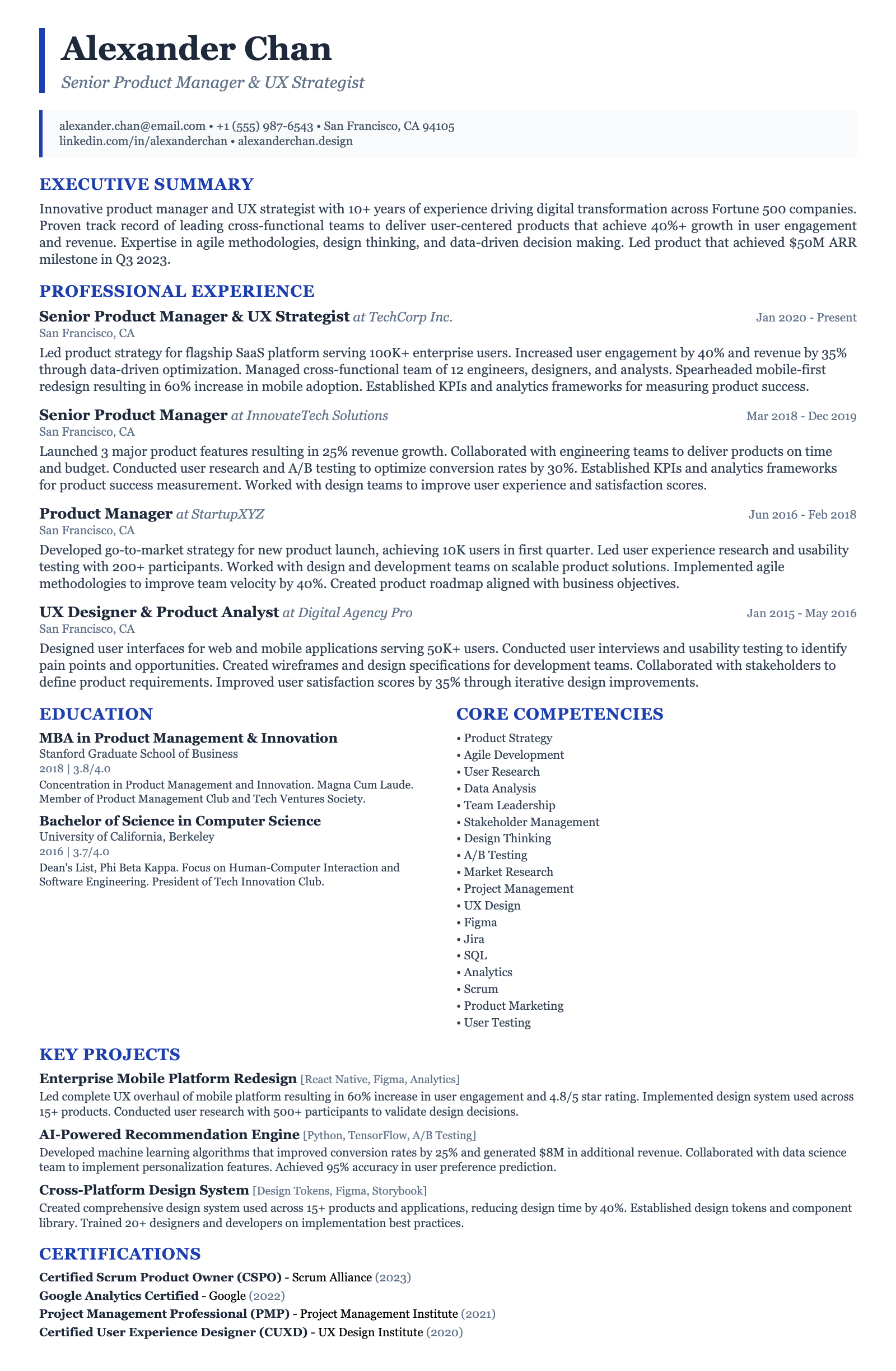
ATS-Optimized for US Market

UX Designer Resume Format (US Edition)

In the US job market, recruiters spend seconds scanning a resume. They look for impact (metrics), clear tech or domain skills, and education. This guide helps you build an ATS-friendly UX Designer resume that passes filters used by top US companies. Use US Letter size, one page for under 10 years experience, and no photo.
Average US Salary: $90k - $160k

Expert Tip: For UX Designer positions in the US, recruiters increasingly look for technical execution and adaptability over simple job duties. This guide is tailored to highlight these specific traits to ensure your resume stands out in the competitive UX Designer sector.

What US Hiring Managers Look For in a UX Designer Resume

When reviewing UX Designer candidates, recruiters and hiring managers in the US focus on a few critical areas. Making these elements clear and easy to find on your resume will improve your chances of moving to the interview stage.

  • Relevant experience and impact in UX Designer or closely related roles.
  • Clear, measurable achievements (metrics, scope, outcomes) rather than duties.
  • Skills and keywords that match the job description and ATS requirements.
  • Professional formatting and no spelling or grammar errors.
  • Consistency between your resume, LinkedIn, and application.
  • Proficiency in key areas such as Problem Solving, Programming, Cloud Services.

Essential Skills for UX Designer

Include these keywords in your resume to pass ATS screening and impress recruiters.

Must-Have Skills

  • HighProblem Solving
  • HighProgramming

Technical Skills

  • MediumCloud Services
  • MediumDatabase Management

Soft Skills

  • CriticalTeamwork
  • HighAdaptability

A Day in the Life

Each day as a UX Designer brings diverse challenges. It often starts with reviewing user research data from platforms like UserTesting.com or conducting usability testing sessions. A significant portion of the morning is dedicated to collaborating with product managers and engineers in stand-up meetings to discuss project progress and address any roadblocks. Following this, I might spend time wireframing new features in tools like Figma or Sketch, ensuring they align with user needs and business goals. Afternoon tasks could involve creating interactive prototypes using InVision or Adobe XD, followed by presenting these designs to stakeholders for feedback. Throughout the day, I constantly iterate on designs based on user feedback and data analysis from tools like Google Analytics, and document design decisions in platforms like Confluence.

Career Progression Path

Level 1

Junior UX Designer (Entry Level)

Level 2

Associate UX Designer

Level 3

Senior UX Designer

Level 4

Lead UX Designer

Level 5

Manager / Principal

Interview Questions & Answers

Prepare for your UX Designer interview with these commonly asked questions.

Describe a time when you had to advocate for the user in a project where stakeholders had conflicting priorities. How did you handle it?

Medium
Behavioral
Sample Answer
In a recent project, stakeholders wanted to prioritize a feature based on business goals, but user research indicated it would negatively impact the user experience. I presented the research findings, highlighting the potential negative consequences on user satisfaction and long-term engagement. I proposed an alternative design solution that addressed both business goals and user needs, which ultimately led to a successful compromise that satisfied all parties. Data and clear communication were key.

Walk me through your design process for a recent project, from initial concept to final delivery. What tools did you use, and what challenges did you encounter?

Medium
Technical
Sample Answer
For a recent mobile app redesign, I started with user research, conducting interviews and surveys to understand user pain points. Based on these insights, I created user personas and journey maps. I then moved to wireframing in Sketch, followed by prototyping in InVision. Usability testing revealed navigation issues, which I addressed through iterative design changes. The main challenge was balancing user needs with technical constraints, which required close collaboration with the engineering team. The final deliverable was a high-fidelity prototype and design specifications.

Imagine a situation where you have to redesign a website with very little user data available. How would you approach the project?

Medium
Situational
Sample Answer
In a situation with limited user data, I would start by conducting a heuristic evaluation of the existing website to identify potential usability issues. I would then perform a competitive analysis to understand industry best practices and identify opportunities for improvement. Next, I would conduct informal user interviews with a small sample of users to gather qualitative feedback. Based on these insights, I would develop a hypothesis and create prototypes to test with users before making significant design changes.

Describe a time you had to work with a difficult team member. What was the situation, and how did you resolve it?

Medium
Behavioral
Sample Answer
I once worked with a developer who was resistant to implementing design changes based on user feedback. I scheduled a meeting to understand his concerns and explain the rationale behind the changes, emphasizing the positive impact on user experience and business goals. By actively listening to his concerns and collaboratively finding solutions, we were able to build a better working relationship and successfully implement the design changes. Open communication and empathy are essential.

How do you stay up-to-date with the latest UX design trends and technologies?

Easy
Technical
Sample Answer
I stay current by actively participating in online communities like UX Design Collective and Dribbble, attending industry conferences such as UXPA International, and reading articles and books by thought leaders in the field. I also experiment with new design tools and technologies, such as Figma's latest features or advancements in AR/VR design, to expand my skillset and stay ahead of the curve. Continuous learning is crucial in the ever-evolving field of UX design.

You are tasked with improving the user experience of a low-performing e-commerce website. What metrics would you track to measure the success of your redesign?

Hard
Technical
Sample Answer
To measure the success of an e-commerce website redesign, I would track key metrics such as conversion rate, bounce rate, average order value, cart abandonment rate, and task completion rate. I would also monitor user satisfaction through surveys and usability testing. By analyzing these metrics before and after the redesign, I can objectively assess the impact of my design decisions and identify areas for further improvement. Tools like Google Analytics and Hotjar would be critical for data collection.

ATS Optimization Tips

Make sure your resume passes Applicant Tracking Systems used by US employers.

Use exact keywords from the job description related to UX methodologies (e.g., 'user research', 'usability testing', 'interaction design') and tools (e.g., 'Figma', 'Sketch', 'Adobe XD') throughout your resume.
Structure your skills section with both hard and soft skills, listing specific software proficiencies and design methodologies in a clear, bulleted format.
Quantify your accomplishments whenever possible. Use metrics to demonstrate the impact of your design decisions, such as 'Increased user engagement by 20%' or 'Reduced bounce rate by 15%'.
Use standard section headings such as 'Summary,' 'Experience,' 'Skills,' and 'Education.' Avoid creative or non-standard headings that may confuse ATS systems.
When describing your work experience, use action verbs to start each bullet point. For example, 'Led', 'Designed', 'Developed', 'Conducted', and 'Implemented'.
Include a dedicated 'Tools' or 'Software Proficiency' section to list all the UX design tools you are familiar with. This helps ATS systems quickly identify your technical skills.
Ensure your contact information is clearly visible and easily parsed by ATS. Include your name, phone number, email address, and a link to your online portfolio or LinkedIn profile.
Save your resume as a PDF to preserve formatting and ensure it is readable by ATS systems. Avoid using tables or columns, as these can sometimes cause parsing issues.

Common Resume Mistakes to Avoid

Don't make these errors that get resumes rejected.

1
Listing only job duties without quantifiable achievements or impact.
2
Using a generic resume for every UX Designer application instead of tailoring to the job.
3
Including irrelevant or outdated experience that dilutes your message.
4
Using complex layouts, graphics, or columns that break ATS parsing.
5
Leaving gaps unexplained or using vague dates.
6
Writing a long summary or objective instead of a concise, achievement-focused one.

Industry Outlook

The US market for UX Designer professionals remains highly competitive. Recruiters and ATS systems prioritize action verbs, quantifiable outcomes (e.g., "Reduced latency by 40%", "Led a team of 8"), and clear alignment with job descriptions. Candidates who demonstrate measurable impact and US-relevant certifications—coupled with a one-page, no-photo resume—see significantly higher callback rates in major hubs like California, Texas, and New York.

Top Hiring Companies

GoogleAmazonMeta

Recommended Resume Templates

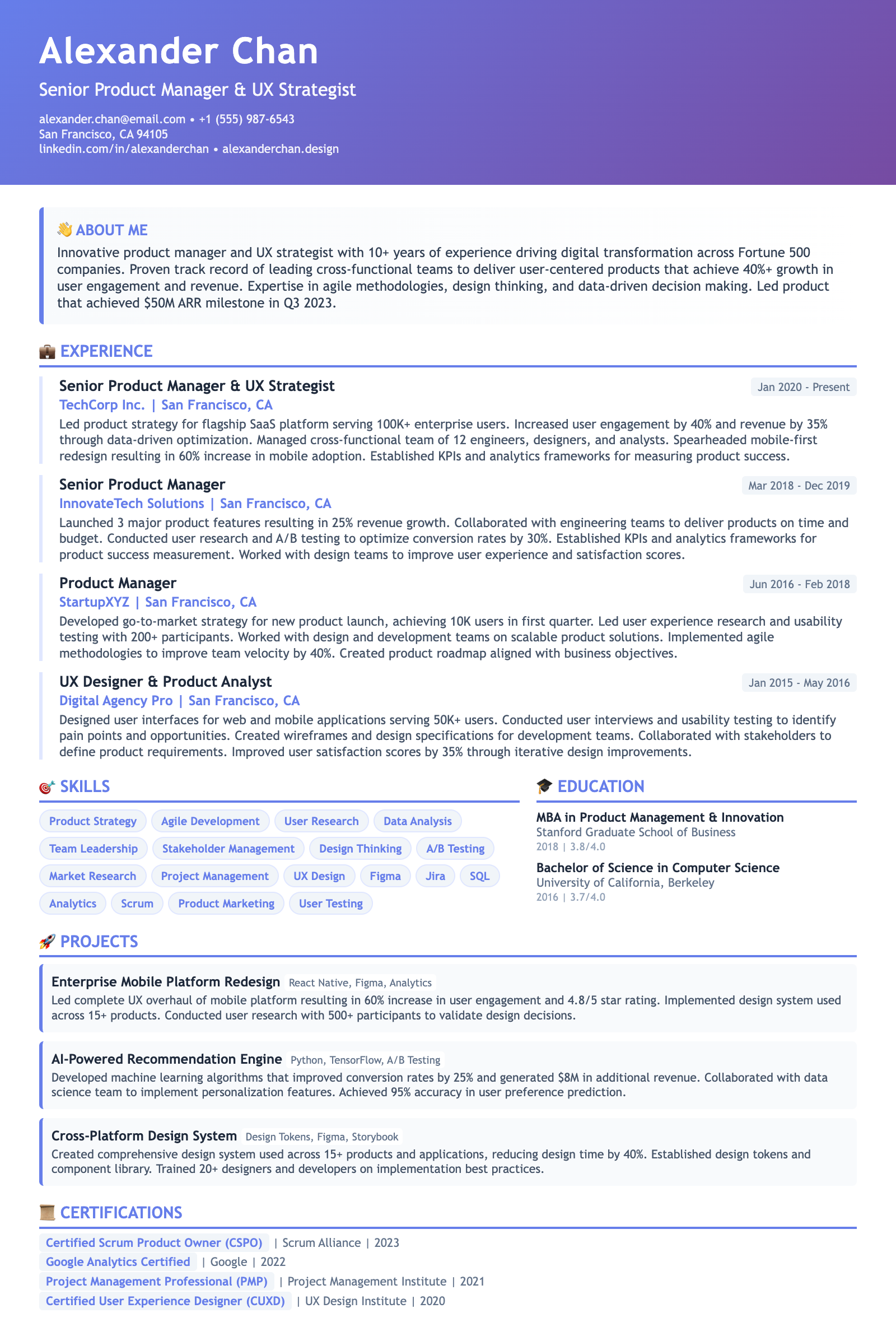
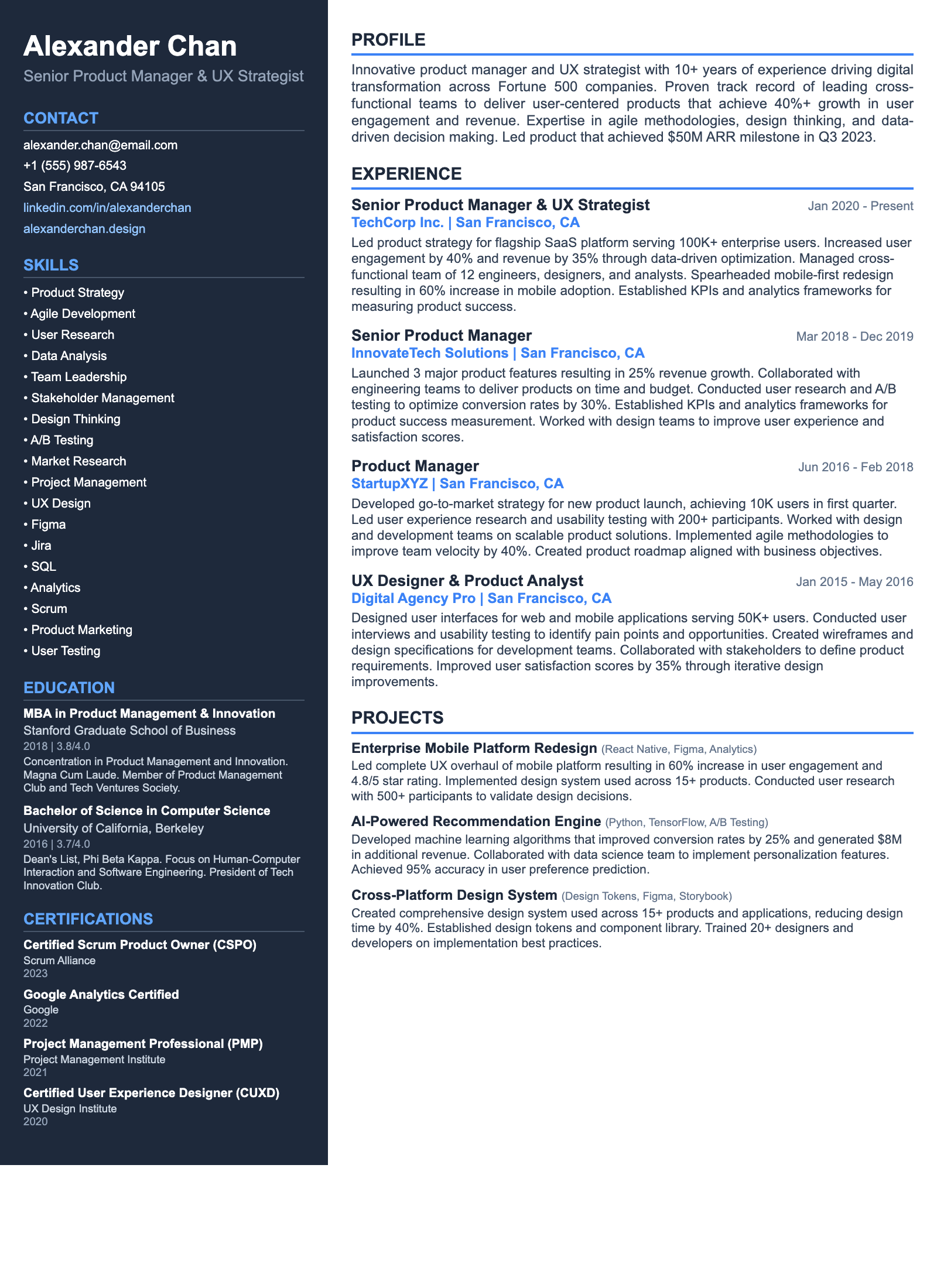
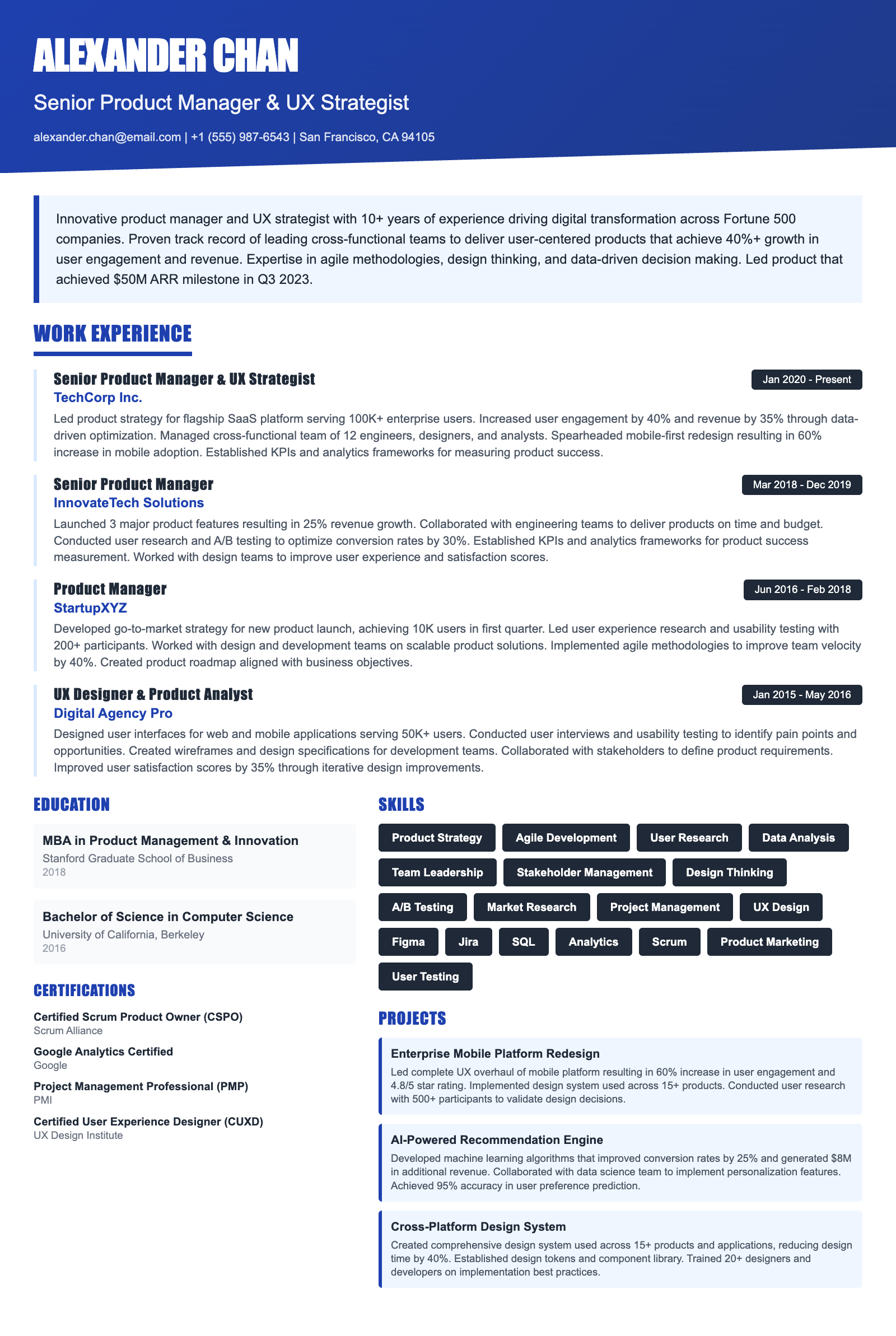
ATS-friendly templates designed specifically for UX Designer positions in the US market.
Frequently Asked Questions

How long should my UX Designer resume be?

Ideally, a UX Designer resume should be one to two pages. For entry-level to mid-level roles, one page is often sufficient. If you have extensive experience (10+ years) or a substantial portfolio of projects, a two-page resume is acceptable. Ensure every element is relevant to the target role, highlighting key skills like user research, wireframing (using tools like Figma or Sketch), and prototyping.

What are the most crucial skills to highlight on my UX Designer resume?

Emphasize both hard and soft skills. Essential hard skills include proficiency in UX design software (e.g., Adobe XD, Sketch, Figma), wireframing, prototyping, user research (usability testing, surveys), information architecture, and interaction design. Soft skills like problem-solving, communication, teamwork, and empathy are equally important. Quantify your impact whenever possible, e.g., 'Improved user satisfaction scores by 15% through redesigning the user interface'.

How can I make my UX Designer resume ATS-friendly?

Use a clean, simple resume format without excessive graphics or tables that ATS systems might misinterpret. Incorporate relevant keywords from the job description throughout your resume, particularly in the skills and experience sections. Save your resume as a PDF, as this format preserves formatting better than .doc or .docx. Ensure your resume is easily readable by using standard fonts like Arial or Calibri.

Are UX design certifications worth mentioning on my resume?

Yes, UX design certifications can enhance your credibility and demonstrate your commitment to professional development. Consider certifications from the Nielsen Norman Group, Interaction Design Foundation, or Google UX Design Professional Certificate. List these certifications in a dedicated 'Certifications' section, including the issuing organization and completion date. Briefly mention the skills you gained from each certification, such as conducting user research or creating wireframes.

What are common mistakes to avoid on a UX Designer resume?

Avoid generic resume templates that lack customization. Don't omit a link to your online portfolio – it's crucial for showcasing your work. Refrain from using overly creative or unconventional resume formats, as they may not be ATS-friendly. Proofread carefully to eliminate typos and grammatical errors. Overstating your skills or exaggerating your experience can also be detrimental.

How can I transition into UX Design with a non-design background?

Highlight transferable skills from your previous role, such as problem-solving, communication, and analytical abilities. Emphasize any user-centered projects you've worked on, even if they weren't explicitly UX-related. Showcase your passion for UX design by completing online courses, building a portfolio of personal projects, and networking with UX professionals. Tailor your resume to emphasize your understanding of UX principles and your eagerness to learn tools like Figma, Sketch, and Adobe XD.

Ready to Build Your UX Designer Resume?

Use our AI-powered resume builder to create an ATS-optimized resume tailored for UX Designer positions in the US market.
Complete UX Designer Career Toolkit

Everything you need for your UX Designer job search — all in one platform.

Why choose ResumeGyani over Zety or Resume.io?

The only platform with AI mock interviews + resume builder + job search + career coaching — all in one.

See comparison

Last updated: March 2026 · Content reviewed by certified resume writers · Optimized for US job market

Best UX Designer Resume Format for USA (2025) - Download Free